How is the Netherlands responding to the threat of this globally invasive pest? By Anna Mouton.
Entomologist Dr Karin Winkler is a researcher at Wageningen University and Research. She is based at the Fruit Research Centre in Randwijk, where she works on crop protection and the role of biodiverse agro-ecosystems in pest control.
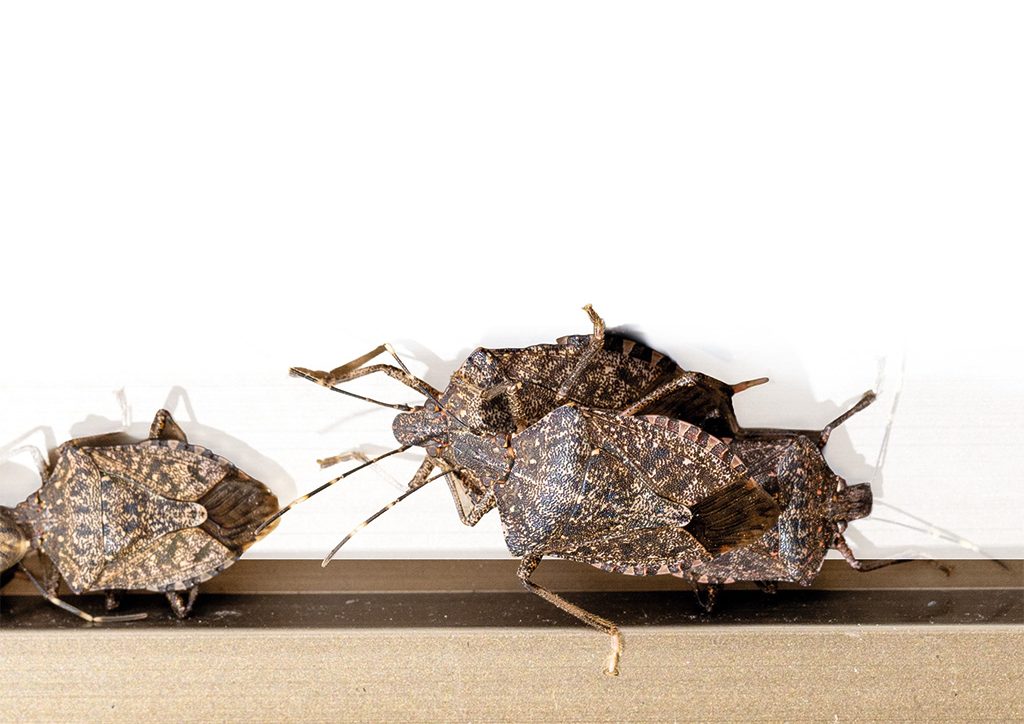
Winkler spoke to Fresh Quarterly about the rapid spread of the brown marmorated stink bug (Halyomorpha halys) throughout the Netherlands and the challenges of controlling this adaptable insect.
Q. Why are these bugs a threat to pome-fruit growers?
We first recorded brown marmorated stink bugs in the Netherlands in late 2018. Of course, we were afraid of what that could mean for Dutch growers, as the bugs can cause dramatic losses in apple and pear production.
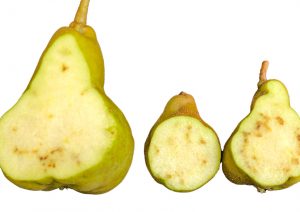
Brown marmorated stink bugs caused giant problems in Italy in 2019. Due to spring frosts, Italian growers had fewer pears on their trees. Then the fruit became malformed due to bugs sucking on developing fruits during the summer.
When they took the fruit out of storage, they also saw that many of the fruit were rotting, especially on the upper part [stem end] of the fruit, which the Italians attributed to piercing by the bugs late in the season.
If the bugs pierce fully grown fruit just before harvest, it doesn’t cause malformation because there is no more cell division, but it creates an entrance hole for fungi and bacteria.
Q. How were the bugs introduced and spread?
I think trade and transport are how most of the bugs enter the Netherlands. It’s not so much the natural spread from France or Germany, although that is possible as well.
During the last five or six years, the stink bugs spread over nearly the whole country. We used a citizen-science approach to monitor spread. We placed requests in newspapers for people to report the bugs, and there’s a website where they can do this. Their findings are validated based on photos.
We often got this story: people went on holiday in autumn somewhere in the Mediterranean. Then, when they came back, they found these bugs in their camper vans because, in autumn, the adult bugs look for overwintering sites and hide in all sorts of crevices and cavities, even in the laundry.
In this way, people continuously bring adult bugs into the Netherlands and spread them. People store their camper van somewhere frost-free during winter, and next spring they travel through the Netherlands for a camping holiday. It’s warm, so the bugs become active again.
The bugs are also spread with international trade. One striking example we had was a fruit farmer who got hail netting from a company in Italy. With the hail netting, bugs came to his orchards. So, he tried to protect his crop from hail, but then he got bugs.
Q. What have you learnt about the bugs’ life cycle?
We studied the local phenology over five years. In the Netherlands, we only get one generation per year. The reproduction of this bug seems to be limited by the day length. When the days become longer than the nights, they become reproductively active. In our case, that’s in April, and then they start laying eggs in mid-May or early June.
Even if February or March is very warm, the days are not long enough, and they don’t reproduce. That’s very good because if it becomes warmer here due to climate change and the bugs were to start reproducing earlier, they would have a better chance of a second generation, and to really increase the population.
In four of the five years, the new generation started laying eggs, and in two, those eggs hatched, and nymphs emerged. There were very few nymphs from the second generation, but we still had nymphs from the first generation, as females laid eggs continuously during the summer.
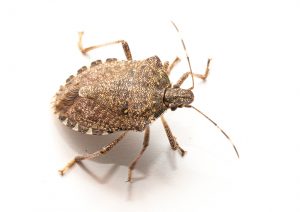
We never saw nymphs surviving winter. As far as I understand it, they’re so programmed on growing and becoming adults that they don’t have a strategy of switching to storing reserves when the days become shorter. Nymphs don’t contribute to the population next year, but they can still do damage this year.
I am pretty sure that the large problem in Italy in 2019 was caused by very high spring temperatures, which allowed the bugs to lay many of their eggs early in the season, causing a large second generation of nymphs that overlapped with the first generation.
Q. How successful is monitoring for the bugs?
The tricky thing for us is that these piercing bugs typically cause deformed growth, because where the bug pierces, the cells die, while the rest of the fruit keeps growing. But this deformation is only visible 3–5 weeks after the attack.
So, if you see a bug walking around in the orchard, you don’t know what she has done until three weeks later. We had only one farmer who observed Halyomorpha halys, then came back four weeks later, and saw the damage on his pears. It’s hard to make this connection because we also have other bug species in the orchard.
We experimented with different kinds of traps, and we found that sticky traps with a combined lure for stink bugs worked best for us. The only problem is that the combined lures attract the bugs, but not necessarily to the sticky trap.
The bugs may land in the vicinity of the trap, and they also release aggregation pheromones. If there are five bugs on a twig, that may be as attractive as the lure on the trap. We’ve had these traps on eight or nine farms, and we advised the farmers to also look for bugs on the twigs next to the traps.
We also did some experiments with traps combined with placing catalpa trees near the orchard. Catalpa is popular with Halyomorpha halys, so we thought it would improve the chance of finding them. But what do you do with that information if you don’t have a method to beat them?
Q. Are any control methods available?
Parasitoids are very good at finding eggs and are for sure one of the most promising approaches to control stink bugs. The eggs of brown marmorated stink bugs have defence mechanisms, and not all our native parasitoids can get through them.
Two parasitoids which specialise in Halyomorpha halys have been discovered. They’re from Asia, but they’ve come to North America and Italy. However, strict regulations in Europe and the Netherlands make it very difficult to release species, even if they are native.
We did a study on the potential of the conservation biological approach. We mainly wanted to find out which parasitoids are around. So, we placed egg batches on little paper strips in two regions of the Netherlands in three different kinds of orchards: conventional, organic, and extensive. Extensive orchards are for private use, self-picking, or adopt-an-apple-tree schemes.
We found that many of the eggs we placed in the orchards were eaten. Some were just missing. We used a camera system to film the eggs, and we analysed the movies. [Watch natural enemies take on the stink bug eggs here.]
We saw that earwigs have difficulties with these large eggs. Harvestmen seemed to be effective, but our heroes were bush crickets. They were eating impressively. And we also saw birds picking the eggs away. Not all eggs that went missing had camera systems, so we assume that lady beetle larvae and carabids might also play a role, but we didn’t see them.
The conventional and organic farms had less than 10% missing or chewed eggs, but the extensive farm had nearly 40%. We exposed the egg batches for only three days, and eggs take about seven days to develop, so in an orchard, they would be exposed to potential enemies for twice as long.
Some of the extensive systems had traditional high trees, and the grass is mowed only twice per year. So, for us, the question is how we can promote these species in a conventional orchard?
Q. Will brown marmorated stink bugs exacerbate existing stink bug damage?
In the Netherlands, most stink bug damage is done by Pentatoma rufipes, a native species that has increased during the past 20 years and is causing more damage. We think it’s partly due to temperature, as winters are not that cold anymore, so more survive, and partly due to reduced broad-spectrum insecticide use.
On some farms, we see Pentatoma rufipes regularly at high densities, and we do not yet see Halyomorpha halys. So, our best guess is that most of the damage is done by Pentatoma rufipes. It’s not possible to tell based on the damage itself.
The two species use separate niches. Pentatoma rufipes overwinters as a second nymphal stage, so they only lay eggs in a short period during August or September. It doesn’t have as many host plants as Halyomorpha halys, but it uses 20 or 25 woody species. Halyomorpha halys starts laying eggs in May or June on a high number of different host plants.
So, I don’t think the resources are limiting for these two species at all. They can coexist perfectly. The brown marmorated stink bug won’t replace other species, but they could be additive.
We simply don’t know whether the Netherlands is on the edge of the brown marmorated stink bug’s spread and the area at risk of damage. Are we going to keep seeing high numbers everywhere in the country but low numbers in orchards? Or is this the quiet before the storm?
*
Brown marmorated stink bugs have not been reported from South Africa, but would likely cause serious problems if introduced here. Read more about this pest in Fresh Quarterly issue 17.
Related Posts:
Brown marmorated stink bug What do growers, chocolate lovers, car manufacturers, and homeowners have in common? Hostility to brown marmorated stink bugs. By Anna…
Integrated mealy bug management Growers must adopt a strategic approach to overcome this ancient pest. By Anna Mouton. Mealy bugs co-evolved with vascular plants…
Debugging pome fruit What have we learnt about sap-sucking insects in apple and pear orchards? By Anna Mouton. The order Hemiptera contains more…
What is pear stony pit? Conflicting views on a century-old disease. By Anna Mouton. Pear stony pit is a disease of pear trees that shows…
Case study: effective plant improvement The Netherlands is a small country that packs a powerful horticultural punch —can the South African pome- and stone-fruit industries…
The six-legged hitchhiker The tiny grain pest catching a ride on our fruit. By Grethe Bestbier. The grain chinch-bug — Macchiademus diplopterus —…