What have we learnt about sap-sucking insects in apple and pear orchards? By Anna Mouton.
The order Hemiptera contains more than 80 000 insect species that use their piercing-sucking mouthparts to extract bodily fluids from other organisms. Some, such as bedbugs, feed on blood, and some hunt other insects or small animals. But most hemipterans exploit the nutritious sap of vascular plants.
Many sap-sucking hemipterans are important agricultural pests. Common offenders in pome-fruit orchards include woolly apple aphids, armoured scales, and mealy bugs. This article, however, focuses on the typical bugs in the group Heteroptera, which were the subject of a recent Hortgro-funded study led by Dr Minette Karsten, Crop Protection Programme Manager at Hortgro Science.
Heteroptera are characterised by leathery forewings and include assassin bugs, capsid bugs, cotton stainers, stink bugs, and twig wilters.
Depressed and deformed
Heteropterans feed by inserting a needle-like stylet into plant tissues. They pump enzyme-rich saliva into the plant to predigest its cells and then suck up the smoothie-like fluid. The subsequent fruit damage depends on when the insects feed.
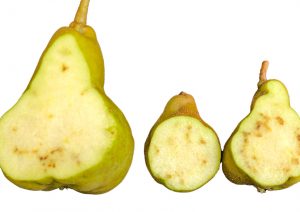
Feeding during the cell-division phase halts growth in the affected part of the fruit, resulting in abnormal development. The earlier the feeding, the more severe the malformation, especially when there are multiple wounds (figure 1). Later feeding causes surface depressions associated with corky spots directly under the skin (figures 2 and 3).
AC Kleynhans, the MSc student on the Hortgro-funded project, worked on bug damage in pome orchards in Elgin and the Langkloof. “In my study, we saw that the external dimples aren’t always visible when the bugs feed very late,” he says. This can lead to unexpected rejections when the internal lesions are eventually discovered.
Kleynhans surveyed twelve commercial apple and pear orchards during the 2023–2024 growing season. He also tested trees for apple stem-pitting virus, demonstrating that the fruit deformities were not caused by pear stony pit disease.
The study confirmed growers’ observations that antestia (Antestiopsis thunbergii thunbergii) is the primary problem bug in Elgin, while the red bug (Cenaeus carnifex) is the main culprit in the Langkloof. Although these bugs cause similar damage, Kleynhans’ work highlighted differences in their biology that have implications for management.
Antestia bugs
Antestiopsis thunbergii thunbergii adults are about 8 mm long and patterned in orange, grey, and yellow-green on a black background. The bugs can be distinguished by three white stripes on the head, a single orange spot behind the head, and two orange spots on the back (figure 4).
Females lay clusters of 9–15 eggs on plants. After hatching, the first instars huddle around the eggshells until their first moult. They then disperse to start feeding.
The bugs undergo five flightless instar stages before adulthood. There is no pupal stage. Development from egg to adult takes about three months at 25 °C, and adults are strong fliers.
Antestiopsis thunbergii thunbergii occurs throughout southern Africa on a wide range of hosts. It’s long been recognised as a sporadic pest of deciduous fruit but achieved its greatest notoriety in coffee, where it reduces yields and triggers potato taste defect.
“Antestia tends to cause damage wherever there are pine windbreaks,” says Kleynhans. “The whole block won’t necessarily be affected, but the rows closest to the windbreaks will be.” Antestia also gravitates to Dutch or Italian alder (Alnus cordata) windbreaks.
Kleynhans believes that the withdrawal of several active ingredients from spray programmes contributed to the rise in antestia damage in Elgin.
Red bugs
Cenaeus carnifex adults are about 9 mm long and — no surprise — red. They develop a black diamond-shaped marking on their back as they mature. The bugs are so frequently seen mating that some people refer to them as love bugs (figure 5).
Little is known about their life cycle. Based on studies of closely related species and Kleynhans’ observations, the bugs probably lay a few eggs at a time in soil crevices or plant debris. First-instar nymphs shelter beneath the soil surface. There are five instars, and development from egg to adult takes 1–3 months.
Adult red bugs occur as long- and short-winged forms. Although the long-winged forms can supposedly fly, neither of the two forms appears to do so, even on warm days or when disturbed. “I’ve never seen a red bug fly,” says Kleynhans.
Cenaeus carnifex is native to the Western Cape and feeds on a wide range of plants, including many common orchard weeds. However, it prefers mallows, particularly kiesieblaar (Malva parviflora).
In the Langkloof, red bugs have emerged as a sporadic pest in recent years. To confirm that they are responsible for the fruit damage, Kleynhans enclosed fruit in mesh bags and introduced bugs into some of these at different stages of fruit development. He notes that pears show more damage than apples, and that the bugs seem to prefer pears.
“The older farmers say the bugs have been around for 60 or 70 years, but only started causing damage now,” says Kleynhans. “We assume it’s because of the drought that’s removed the bugs’ natural food source, so now they’re moving into the fruit trees.”
Unlike antestia bugs, which tend to damage fruit on orchard edges, red bugs feed and breed on weeds and can damage fruit throughout the orchard.
Although Kleynhans’ surveys didn’t include Ceres and its surroundings, red bugs have also been reported from there. Based on DNA analysis, the same species occurs in Ceres, the EGVV, and the Langkloof.
The challenges of monitoring
“Sucking insects are difficult to monitor,” says applied entomologist Dr Schalk Schoeman. “And low numbers can cause a lot of damage.”
Schoeman has extensive experience with sucking insects in several crops, but he specialises in subtropicals such as avocados and macadamias, where sucking insects cause significant economic losses. He lists several monitoring methods, including scouting, fogging, and damage assessments, but admits that they’re not widely implemented.
“Many growers have found that they spray at the same frequency regardless of whether they monitor,” he says. “We haven’t found an answer for monitoring bugs.”
Kleynhans investigated monitoring in apples and pears and arrived at the same conclusion. “Visual scouting for antestia doesn’t work, and fogging is impractical,” he comments. “I don’t know of a grower who is going to buy a machine so they can fog all their blocks every week at four in the morning to check whether they have bugs or not.”
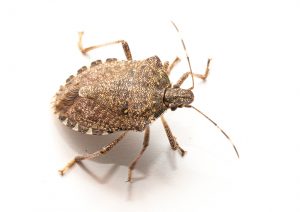
Both Schoeman and Kleynhans would like to see pheromone-based traps for monitoring, but these are not currently available. Kleynhans experimented with a brown marmorated stink bug lure supplied by Chempac, but the results were disappointing.
In contrast to the sex pheromones used in fruit fly and tortricid moth management, the bug pheromones used as lures mostly stimulate aggregation and feeding. Besides monitoring, these pheromones would be invaluable for attract-and-kill products.
For now, Kleynhans recommends fruit damage assessment in blocks with a history of antestia damage, especially those adjacent to pines. “People must also be on the lookout for young bugs, because they do cause damage — sometimes more than the adults,” he says.
Unlike the shy antestia bugs, the uninhibited red bugs are usually easy to spot in the orchard. “If you know you had damage in the previous season, you can keep an eye on the red bugs to see whether they start feeding on your fruit,” says Kleynhans. “I definitely don’t recommend fogging for them.”
Non-chemical control options
Removing alternative hosts is likely to affect bug numbers in orchards, but not always in a good way. “It could be that they move into your crop,” says Kleynhans. “In the case of red bugs, do you spray your ridges clean to remove kiesieblaar, and then the bugs climb into the trees? Or do you leave the kiesieblaar to keep the bugs on the ground?”
Schoeman describes seeing massive damage in macadamia orchards adjoining soya fields. Soya is an excellent host for sucking insects. The bugs multiply in the soya, swamping the macadamias after the soya is harvested.
Within pome-fruit orchards, canopy management facilitates spray applications. There is also evidence from other crop types that more open canopies may discourage antestia bugs. Dense foliage offers better habitat for antestia, which prefer cool conditions.
When correctly implemented, stem barriers can almost be a standalone control method for red bugs. They also help with woolly apple aphid and weevil management. “But then you must have clean ridges,” cautions Kleynhans. “If you have weeds, the bugs climb up them, similar to weevils.”
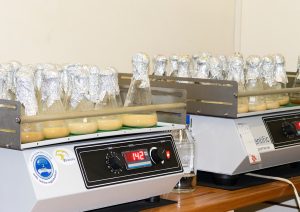
As part of the Hortgro-funded project, Kleynhans tested entomopathogenic fungi against red bugs in the laboratory. He found some to be effective, although this would need to be confirmed through field trials. In his experiments, Metarhizium anisopliae produced higher mortalities than Beauveria bassiana.
Parasitoids were not included in this project, but could eventually play a pivotal role in the integrated pest management of sucking insects. For example, Schoeman is working with Koppert to test the parasitic wasp Trissolcus basalis in macadamias.
“These are commercial-scale trials, which have been running for four years,” he says. “We’ve only sprayed conventional insecticides twice in that time, and we achieve comparable control and nut quality with the parasitoids as with conventional spray programmes.”
Trissolcus basalis is a generalist egg parasitoid, so it could help suppress several bug species. Additionally, parasitic flies such as Trichopoda pennipes and T. giacomellii lay their eggs in large juvenile or adult bugs. These flies were under investigation by the ARC Institute for Tropical and Subtropical Crops, but unfortunately, the responsible researcher retired.
Schoeman would love to see a greater investment in developing biological control for sucking insects. Meanwhile, he advises growers to nurture the naturally occurring parasitoids.
“If we spray bugs with broad-spectrum insecticides, we kill the parasitoids, and we’re back to square one,” he says. “The parasitoids are here. We must practice conservation agriculture to optimise their effect, but it’s difficult.”
Watch Kleynhans present his trials of entomopathogenic fungi for red bug control at the 2025 Hortgro Science Research Showcase on the Hortgro YouTube channel.
Related Posts:
Integrated mealy bug management Growers must adopt a strategic approach to overcome this ancient pest. By Anna Mouton. Mealy bugs co-evolved with vascular plants…
What is pear stony pit? Conflicting views on a century-old disease. By Anna Mouton. Pear stony pit is a disease of pear trees that shows…
Future-proofing pest management Research in biological control is shaping the next agricultural revolution. By Anna Mouton. The so-called green revolution of the sixties…
There is life after chlorpyrifos Growers can achieve effective mealy-bug control with the correct use of existing tools. By Anna Mouton. Chlorpyrifos was a mainstay…
Brown marmorated stink bug What do growers, chocolate lovers, car manufacturers, and homeowners have in common? Hostility to brown marmorated stink bugs. By Anna…
The unstoppable brown marmorated stink bug How is the Netherlands responding to the threat of this globally invasive pest? By Anna Mouton. Entomologist Dr Karin Winkler…