Postharvest hygiene is crucial for maintaining fruit quality and safety during handling and storage. By Anna Mouton.
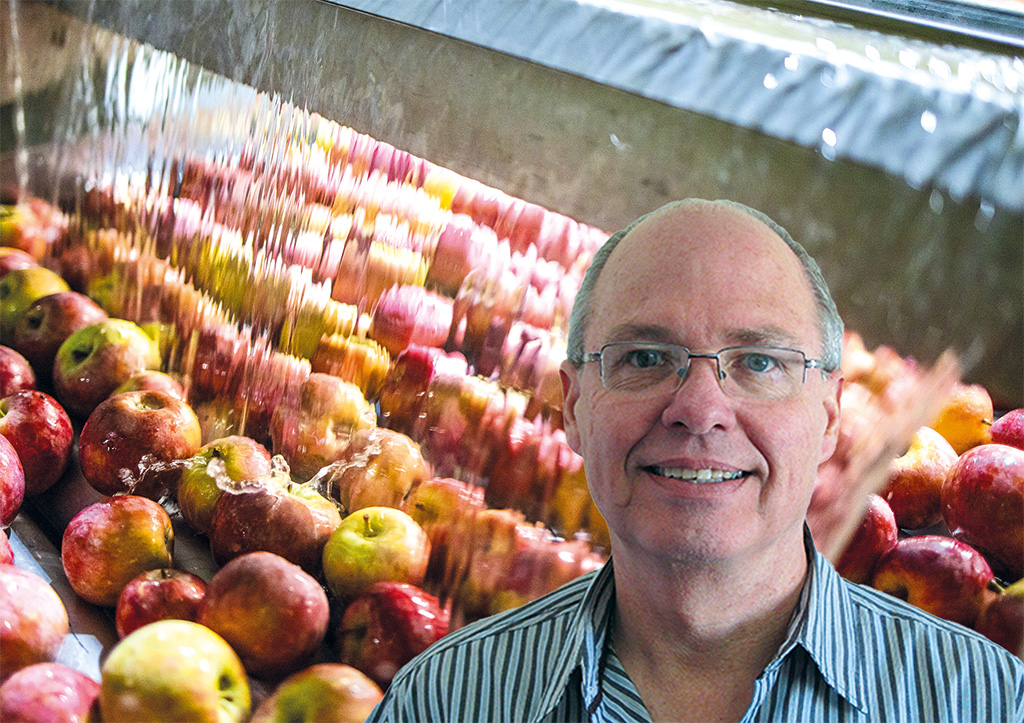
Sanitisers can help prevent postharvest decay and foodborne diseases by reducing microbial numbers, but only if used correctly. “Sanitisers or disinfectants must be part of an integrated approach,” said Dr Johan Fourie, postharvest pathologist at ExperiCo Agri-Research Solutions. “These products are not a quick fix that you can apply before or after storage.”
In a presentation at the recent Hortgro Science Postharvest Symposium, Fourie walked participants through the basics of pack-house sanitation, including different decontamination processes, the criteria for product selection, and strategies for effective hygiene.
Four degrees of decontamination
Decontamination encompasses all processes for removing pathogens. Fourie explained the four degrees of decontamination: cleaning, sanitising, disinfection, and sterilisation. “We often talk about sanitation, but what product are we using? Where does it fit into these different categories?” he asked.
Cleaning is the removal of visible dirt by physical processes such as washing and scrubbing. Cleaning products include soaps and detergents targeting dirt. They can lower microbial levels by rinsing them away, but they’re not designed to kill microbes.
Sanitising aims to kill microbes and lower their numbers to safe levels. Sanitisers are gentler than disinfectants and usually target bacteria rather than fungi. Fungal spores have evolved to survive adverse environments, so it’s to be expected that they’ll be hard to kill.
Disinfection aims to kill all microbes, although it doesn’t consistently achieve 100% elimination. Disinfectants can target bacteria and fungi.
Sterilisation destroys all microbes. It often relies on physical processes such as heat or irradiation. Sterilisation is commonly used in medicine and some types of food processing, such as canning. It’s not applicable to pack houses.
Most sanitisers and disinfectants are inactivated by organic material. Effective sanitising and disinfection, therefore, require the removal of dirt. Many commercial products combine soaps or detergents with sanitisers or disinfectants.
“Another concept that is often ignored is dwell or contact time,” said Fourie. “The dwell time is the minimum time the product needs to be on a surface to kill or reduce the numbers of pathogens effectively.”
He elaborated that the dwell time must be considered in product selection. Slow-acting products are impractical for situations where they are only in contact with microbes for a short time.
“The killing claims of the product are also important,” said Fourie. “What organisms are killed or reduced? Are they the pathogens that are present in your pack house or storage area and part of the decay complex? We know that each pathogen reacts differently to different actives.”
How to choose a product
Besides dwell time and killing claims, Fourie discussed several other criteria for selecting sanitisers or disinfectants. He emphasised that users should begin by carefully reviewing the product registration and the manufacturer’s specifications.
“The active ingredient is obviously very important, also from an acceptability point of view,” he said. “There are some very good sanitisers that, unfortunately, we cannot use.”
Any products that could come into contact with fruit must be food-grade and appropriately registered. There should be no risk of unsafe or unwanted residues on fruit. Market requirements will inevitably influence decisions about active ingredients and products.
Besides not leaving chemical or visible residues, products coming into contact with fruit mustn’t cause phytotoxicity. Products, even those that don’t touch fruit, should be safe for pack-house workers and not corrode or damage pack-house surfaces.
“Then there are logistics, like how often you would have to replace your sanitising water or drench,” said Fourie. The longevity and stability of different products can significantly affect their ease of use in a pack house.
The fate of sanitisers and disinfectants is another consideration. Some products may be effective in theory, but impractical to implement due to poor environmental safety and expensive or impractical disposal methods.
“You need to know all of these things,” said Fourie, “because that’s part of your management strategy and how you’re going to approach using sanitisers or disinfectants.”
Designing a sanitation strategy
“The first step is knowing your processes, where to focus, and where sanitisers or disinfectants will fit in,” said Fourie.
Depending on the fruit type, a pack house will have different areas where specific processes occur. Some, such as the arrival area where fruit are received, tend to be dirty and have a high spore load. Others, such as the packing area, should be clean, but may nonetheless have high spore loads.
Within each area, Fourie described different zones, depending on the proximity to fruit, ranging from direct contact to outside areas, such as locker rooms or loading docks.
The key to effective pack-house hygiene is characterising the risks posed by different zones and areas, and addressing these through the appropriate application of cleaning, sanitation, and disinfection.
“Identify the hot spots and the high-risk zones in your pack house and handling chain, for instance, by monitoring and quantification,” said Fourie. “Focus on those areas to see whether you are reducing the pathogens in those areas effectively.”
He suggests that pack houses implement regular sampling of water, hard surfaces, and air. Besides gaining feedback on whether decontamination practices and products are effective, analyses can identify the organisms present and determine whether they can potentially cause postharvest diseases or foodborne illnesses.
Decontamination should be integrated into a comprehensive quality management system to ensure that products are used safely and effectively. Staff must be trained in basic hygiene and sanitation practices.
Fourie cautioned that sanitisers and disinfectants don’t replace fungicides and can’t compensate for poor cleanliness and hygiene.
“Decontamination starts with the removal of decayed fruit. Don’t bring rotten fruit into your pack house because you’re going to start with a very high spore load,” he said. “The disinfectants or sanitisers will not be sufficient to reduce these numbers.”
Like all chemicals used in fruit production and handling, sanitisers and disinfectants are not silver bullets, concluded Fourie.
“These products have limitations, and you need to be aware of them,” he said. “They’re only as good as your adherence to their specifications. And you have to follow correct principles and remember that the more frequently you sanitise, the better your pack-house hygiene will be.”
The search for safer sanitisers Trials have identified potential alternatives to calcium hypochlorite for sanitising pack-house flume water. By Anna Mouton. Many pome pack houses…
Decay control in the pack house Ongoing research aims to optimise old and discover new methods to maintain fruit quality. By Anna Mouton. Delivering fresh fruit…
Hot topics in crop protection From regulations and research to integrated and regenerative practices. By Anna Mouton. “How will the deciduous-fruit industry transition to more…
Manage food-safety better Consumers’ ideas about high-risk foods are not always reality- or evidence-based. By Engela Duvenage. The story of how Scottish physician…
7 steps to dodge decay Three experts on post-harvest disease share advice for growers. By Anna Mouton. Post-harvest diseases start in the orchard. "What you…
Monitoring and mitigation How can growers best protect their fruit against spotted wing drosophila? By Anna Mouton. The establishment of spotted wing drosophila…