A study on the behaviour of 1-MCP in cold rooms reveals hidden inefficiencies. By Anna Mouton.
The postharvest application of 1-MCP (1-methylcyclopropene) is only effective if every apple in a cold room receives a sufficient dose. But how much of the 1-MCP released during treatment eventually binds to ethylene receptors inside the fruit?
This question was the topic of a presentation by engineer Dr Alemayehu Tsige at the Hortgro Science Postharvest Symposium. Tsige is a senior researcher in the Packaging and Cold Chain Research Group in the Department of Horticultural Science at Stellenbosch University.
He studied the dynamics of 1-MCP in cold rooms for his doctoral research at KU Leuven in Belgium under the supervision of Prof. Bart Nicolaï and Dr Pieter Verboven.
Distribution and absorption
The factors affecting 1-MCP dynamics in cold rooms fall into two broad categories. The first is distribution: does 1-MCP spread evenly so that each fruit is exposed to the same concentration? The second is absorption: are materials in the cold room lowering the 1-MCP concentration by removing it from circulation?
“There are non-target binding sites inside fruit,” said Tsige. “But there are also non-target solid materials such as wooden bins that may participate in 1-MCP uptake.”
To uncover the key physical mechanisms at play, Tsige combined experimental data with mathematical modelling. He measured 1-MCP concentrations and diffusion in progressively larger and more complex environments.
“Each stage was followed with a mathematical model to mimic the process — the physics — of the 1-MCP transport,” explained Tsige. “So the model starts from the simple material level, then goes to the fruit level, the packaging level, and the cold-store level.”
The result is a set of equations that describe how 1-MCP travels through air and in solids, whether in fruit or other materials. These can be used to investigate how different factors influence the amount of 1-MCP available for binding to ethylene receptors.
Precision jar tests
Stage one of Tsige’s experiments involved determining the uptake of 1-MCP by different materials. He exposed apples, as well as wet and dry oak and poplar wood, HDPE (high-density polyethylene) plastic, and cardboard to known concentrations of 1-MCP inside jars and measured the 1-MCP depletion over time.
The uptake by each material depended on its diffusivity — how easily 1-MCP moves through it — and the density of its 1-MCP binding sites. Wood, cardboard, and apples all exhibited high diffusivity, allowing 1-MCP to penetrate them readily.
Surprisingly, wood, cardboard, and HDPE all had a greater density of 1-MCP binding sites than apples. However, the diffusivity of HDPE was extremely low, resulting in minimal 1-MCP uptake.
Oak wood, whether wet or dry, and wet cardboard absorbed more than 80% of the 1-MCP within 24 hours.
“What these results tell us is that these non-target materials — the wooden bins and the cardboard — are indeed competing for the active ingredient in the cold store,” said Tsige.
Upscaling to boxes
The next step involved tracking the movement of 1-MCP within storage units containing fruit. Tsige used slotted HDPE boxes, each holding approximately 20 kg of apples and stacked two high inside an airtight outer container.
1-MCP was generated in a single position on the floor between the two columns of boxes, and circulated using a fan. Tsige measured the air velocity and 1-MCP concentration at various points to determine how air circulation affects the distribution of 1-MCP.
Even without the fan, 1-MCP was distributed throughout the containers within 18 hours.
Tsige then repeated his experiments with different box materials, comparing HDPE to oak wood, and examined the effect of a plastic cover over the top and a portion of the sides of the HDPE boxes.
“The plastic cover had no effect,” said Tsige. “But the wooden box material had a huge impact on 1-MCP depletion.”
Whereas the wooden boxes absorbed nearly a third of the applied 1-MCP, the HDPE boxes did not take up any of the chemical.
Inside cold rooms
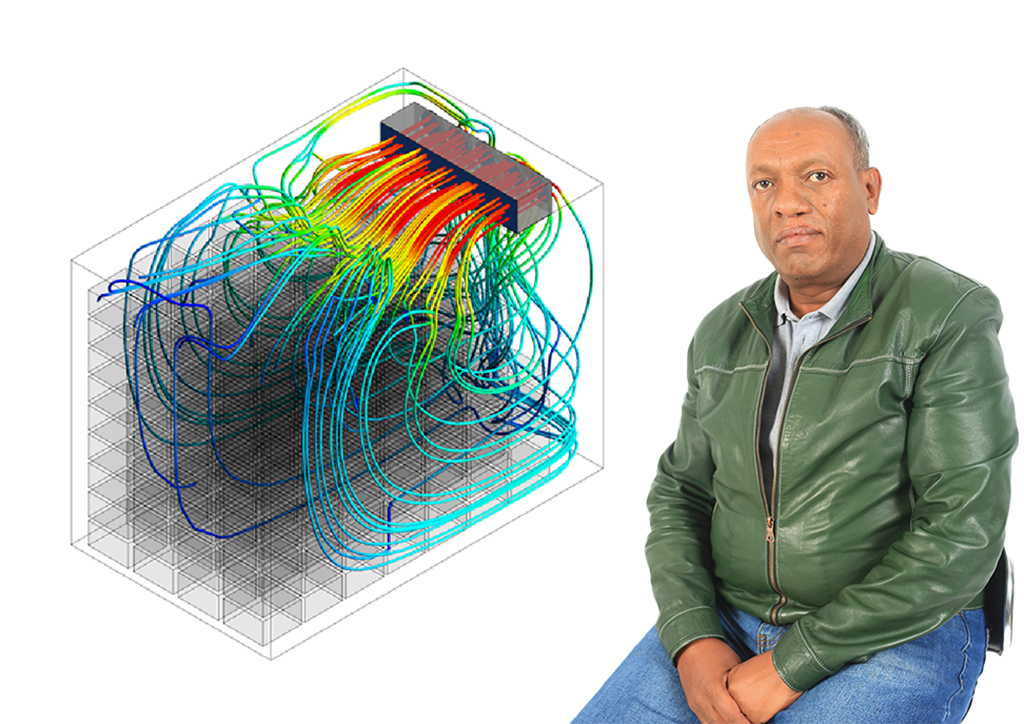
“The next stage was scaling up this analysis to a large commercial cold store,” said Tsige. “The problem here was that it’s almost impossible to model how 1-MCP will enter into individual fruit, so we needed mathematical simplification through using a porous medium modelling technique.”
In this technique, each bin of fruit inside the cold room is modelled as a porous domain, based on previous measurements of how such a bin affects air flow. The model illustrates how the combined effect of all the bins influences the distribution of 1-MCP.
By manipulating the model, Tsige demonstrated that the shape and size of the cold room have minimal effect on 1-MCP distribution. However, room filling affected the amount of 1-MCP required to saturate binding sites in fruit — a greater amount of fruit needed a greater amount of 1-MCP.
The bin material again had a significant impact on the dynamics of 1-MCP. Tsige modelled three 1-MCP doses and found that, at a low dose, the active ingredient was depleted by the wooden bins before the fruit had absorbed enough. At the medium and higher doses, the fruit treatment was completed within 24 hours, regardless of the bin material.
Rethinking 1-MCP dosing
“In conclusion, wooden bins and other plant-based materials have a huge impact on the uptake of 1-MCP,” summarised Tsige. “Industry should take note of this effect.”
Replacing wooden bins with inert materials such as plastics in commercial cold rooms would prevent the loss of 1-MCP and maximise treatment efficiency.
Perhaps more significant is Tsige’s observation that the amount of 1-MCP introduced into a cold room is more than 2 000 times higher than the amount needed to saturate the ethylene binding sites in the fruit.
While acknowledging that high 1-MCP concentrations are necessary to reach the ethylene binding sites inside cells, he still wondered whether current doses might be excessive. “We should strictly follow industry standards for 1-MCP application,” said Tsige. “The results I showed are simply intended to invoke a discussion.”
Watch Tsige’s full presentation on the Hortgro YouTube channel.
Best practices to prevent superficial scald The following applies to all scald-susceptible fruit. Preharvest risk factors Hot and dry weather in the weeks before harvest. Increased…
A model of fruit microstructure Researchers are using advanced medical technologies to unravel the relationship between storage disorders and internal structure in pome fruit. By…
ACC The newly registered 1-aminocyclopropane-1-carboxylic acid (ACC) increases the scope for late thinning of apples. By Anna Mouton. “ACC became available…
How does Fuji respond to cooling? A Hortgro-funded study investigated the effect of different cooling strategies on common storage disorders of Fuji apples. By Anna Mouton.…
Solutions for superficial scald Finding the best long-term storage strategy for Granny Smith apples. By Grethe Bestbier. For acceptance by international markets, not even…