Know the difference between fruit-piercing and fruit-sucking moths and how to protect your fruit against them. By Anna Mouton.
Mention moth pests and many growers will immediately think of either codling or false codling moths. But fruit-piercing moths in the superfamily Noctuoidea can also cause significant economic losses in deciduous and other fruit.
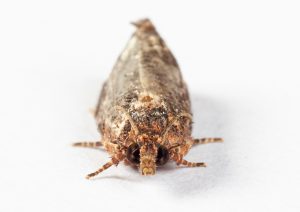
The Noctuoidea is a group of more than 70 000 species of owlet moths found on all continents except Antarctica. Some owlet moth species feed on fruit juices. Fruit-piercing moths have specialised mouthparts with which the adults puncture the fruit. Fruit-sucking moths cannot penetrate the fruit themselves and feed from pre-existing wounds.
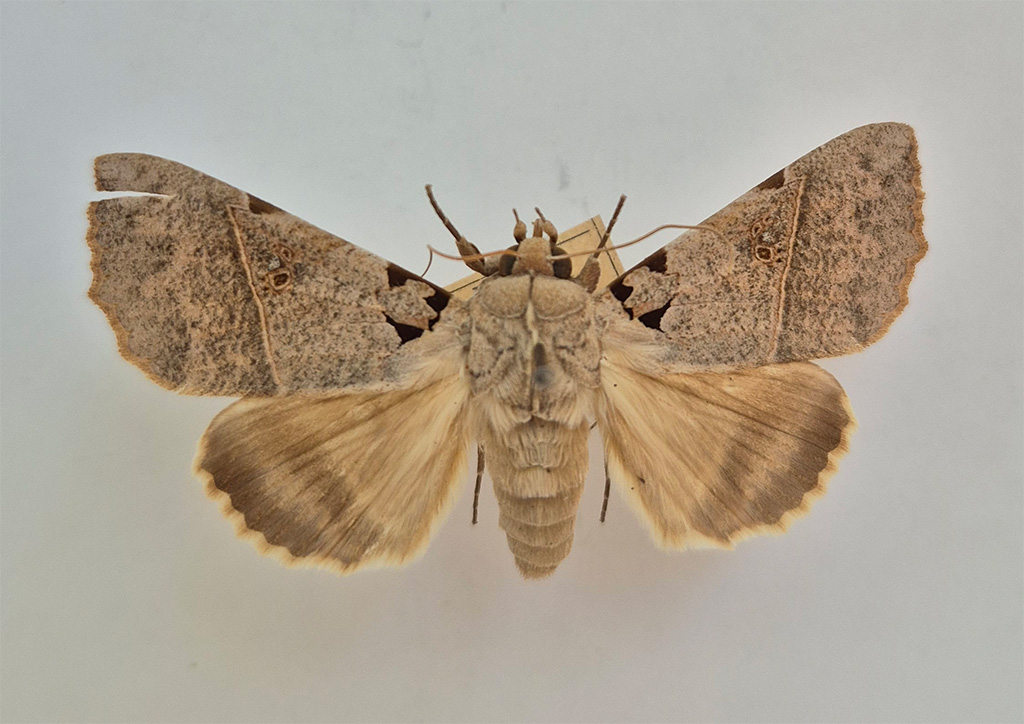
Several fruit-feeding owlet moths are indigenous to South Africa. The most troublesome fruit-piercing moth is the catapult moth (Serrodes partita). Infrequent fruit-piercers include dot underwings (Eudocima (Othreis) materna), Oraesia emarginata, O. provocans, and brown shades (Pericyma (Dugaria) scandulata). The majority of fruit-sucking moths in South African orchards belong to the genus Achaea.
Fruit-piercing and -sucking moths are widespread. Serrodes partita occurs throughout Africa and from Southeast Asia to Australia. In South Africa, damage is mainly reported from the Western Cape. The moths can attack all pome and stone fruit, but appear particularly partial to peaches.
From pinprick to decay
Fruit-piercing moths make a pinprick entry wound with their proboscis and suck juice from a pea-sized area under the wound. The affected flesh becomes dry and spongy, then darkens. Wounds invite opportunistic feeders, such as fruit-sucking moths and vinegar flies, and open the door to decay-causing bacteria and fungi.
On the surface, damage from fruit-piercing moths and fruit flies appears similar, but fruit flies don’t create a spongy area under the entry wounds, whereas the moths don’t lay eggs inside fruit. Keep in mind that vinegar fly larvae may be present in fruit damaged by fruit-piercing moths and should not be confused with fruit fly larvae.
Fruit-piercing moths are attracted to ripe fruit, but some species can damage relatively immature fruit. For his MSc research at the University of Pretoria, Martin Johannsmeier used a penetrometer with an 8-mm tip to measure the firmness of fruit that different moth species could pierce. He found that S. partita made short work of Keimoes peaches and Freestone nectarines with firmnesses of ±13 kg.
Earlier fruit damage leads to accelerated ripening and fruit drop. Damage near harvest may go unnoticed and cause decay after packing and shipping.
Weather-dependent outbreaks
Owlet moths are big. Serrodes partita has a wingspan of 50–60 mm, and mature larvae are 30–55 mm long. Eudocimamaterna can have a wingspan of 85 mm.
Adult moths consume the juice of any ripe fruit, including prickly pears and berries. In addition to deciduous fruit, they are a serious pest of citrus. Johannsmeier studied fruit-piercing moths in apples, peaches, grapes, and figs. He reported that S. partita prefers peaches and that adults sometimes feed on rotten or damaged fruit in addition to sound fruit.
The moths lay eggs in natural vegetation. The jacket plum (Pappea capensis) is the primary larval host of S. partita, but larvae have also been recorded from several alternative hosts. The larvae of other fruit-piercing moths feed on various indigenous trees, shrubs, and vines.
Jacket plums grow over approximately 8 million hectares of the Klein Karoo, eastern Groot Karoo, and eastern Cape. Good rains from late winter to early summer stimulate growth flushes that support vast larval populations. Under these conditions, the moths can complete three generations in one season, with peaks in November, December to January, and February to March.
When S. partita numbers explode, hundreds of thousands of adults disperse in search of food, travelling up to 500 km. They can detect ripening fruit from at least 10 km away. Other fruit-piercing moths follow a similar pattern, but adults are usually fewer and don’t move as far.
Outbreaks of fruit-piercing moths are weather-dependent, tending to occur every 5–10 years following heavy rains in the Klein Karoo and parts of the Groot Karoo. In dry years, countless larvae starve, fewer adults emerge, and fruit damage is usually limited to the Klein Karoo and Langkloof.
Nocturnal raiders
The Noctuoidea are named for their nocturnal habits. Larvae and adults work the night shift, relying on camouflage and cryptic habits to protect them while sleeping during the day.
Owlet moths have excellent night vision, partly due to a light-reflecting layer behind the retina, an adaptation shared by many nocturnal animals, including cats and dogs. This is why the moths’ eyes shine in torchlight at night.
Unlike cats and dogs, moths don’t have a pupil that they can constrict to limit bright light. Instead, a pigment in the moth’s eye migrates to block light from reaching the retina under bright conditions. Pigment migration takes time, so dark-adapted moths avoid bright lights, which prevent them from seeing.
When dark-adapted moths are suddenly caught in light, they settle down and stop feeding.
Several authors state that fruit-piercing moths enter orchards at dusk, numbers peak about three hours later, and moths leave again around midnight. However, Johannsmeier counted moths throughout the night and found a second increase in moths from about 01h00, with moths persisting until 04h00.
Monitoring and management
Fruit-piercing moths are a sporadic pest, and routine monitoring is unnecessary in most orchards. In those with a history of moth damage, problems can be expected roughly two months after good rains in the Karoo.
Defoliation of jacket plum trees in the veld is the first sign of trouble. Heavily infested trees look grey from a distance, making them easier to spot than the cryptic larvae.
In the orchard, feeding and resting moths can be seen at night. Moths converge on the outermost tree rows, particularly on the leeward side of the block, because they fly upwind toward the source of fruit aromas.
There are no specific lures or traps for monitoring. Scouts must inspect the orchards after dusk. They must distinguish between fruit-piercing and -sucking moths, as the latter do not cause primary fruit damage or require control. Both moth types may occur simultaneously, even on a single fruit.
Chemical control of fruit-feeding moths is both impractical and ineffective. Researchers have demonstrated that individual moths only visit an orchard for one night, so even if a grower could kill all the moths on any given night, more would arrive the next. The moths are also not very sensitive to pesticides.
Additionally, late pesticide applications are likely to leave residues on fruit.
Fortunately, effective control is possible. Moths are deterred by light, and trials have shown that 160 W mercury blended lights placed 20 metres apart, about 2 metres outside the orchard, are a barrier to moth incursions. Lights must be positioned about 1.5 metres above the ground.
Alternatively, growers can use extra-wide beam 400 W halogen lamps, placed 100 metres apart and 5 metres high, facing each other.
Lights must be placed on the downwind side at a minimum, but the best protection is to surround the orchard. Orchard margins near natural vegetation and along watercourses are also at increased risk of moth damage.
Results are improved by cutting down natural vegetation within 10 metres of the orchard to prevent it from blocking the light.
Scout for moths from about 2–3 weeks before harvest, concentrating on the ripest fruit on the leeward side of the orchard. Start using the lights as soon as the first moths appear. Switch the lights on before dark to keep moths out, and leave them on until at least midnight, but preferably all night.
False codling moth What growers need to know about control. By Anna Mouton. False codling moth is — you guessed it — a…
Waging war on moth malefactors Does Oriental fruit moth mating disruption work for false codling moth? By Anna Mouton. South Africans have heard a lot…
Healthy tree, healthy fruit Monitoring systems for pome and stone fruit. By Anna Mouton. Orchard health is essential to ensuring consistent yields of quality…
Case study: effective plant improvement The Netherlands is a small country that packs a powerful horticultural punch —can the South African pome- and stone-fruit industries…
The widening circle How a shrinking world is driving evolution in the regulatory environment. By Anna Mouton. The South African fruit industry has…
The false codling moth genome sequence Paving the way for next-generation pest control. By Anna Mouton. “There’s been rapid growth in pest control methods that are…