From regulations and research to integrated and regenerative practices. By Anna Mouton.
“How will the deciduous-fruit industry transition to more sustainable pest and disease management in a world where traditional actives are disappearing?” asked Dr Minette Karsten, Crop Protection Programme Manager at Hortgro Science.
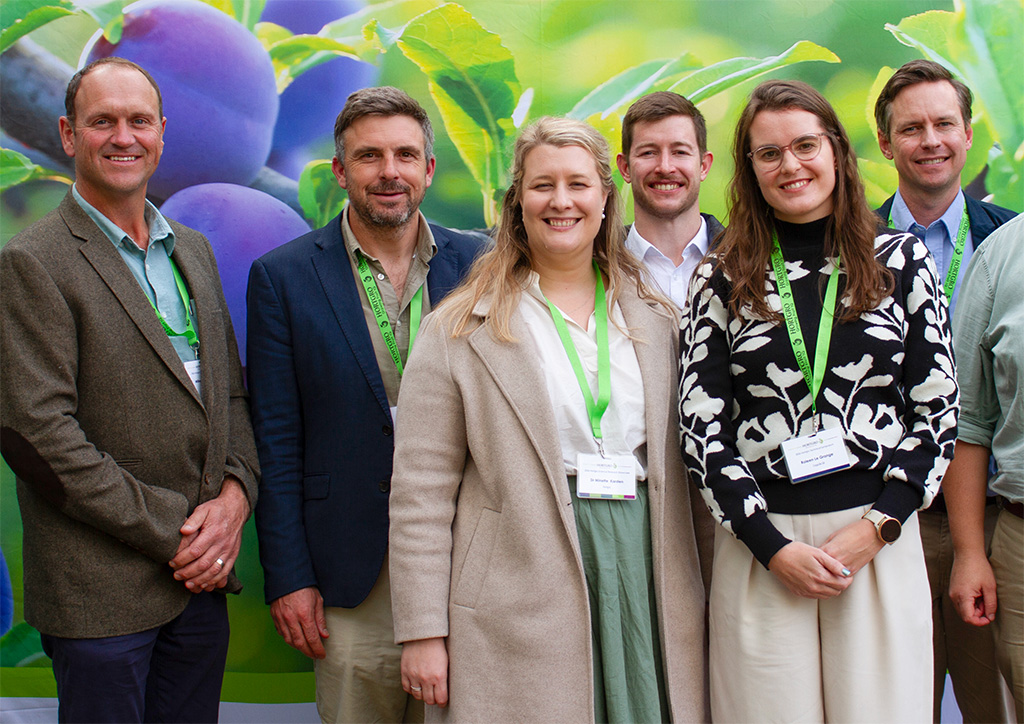
This question was the topic of the crop-protection panel discussion at the 2026 Hortgro Technical Symposium, chaired by Karsten, and comprising Dr Francois (Gulu) Bekker, Dr Murray Dunn, Jacques Fouché, Wilhelm Joubert, and Roleen la Grange.
What follows is a summary of the highlights. For the full panel discussion, visit the Hortgro YouTube channel.
The outlook for actives
Roleen la Grange, CropLife SA
La Grange leads the regulatory portfolio at CropLife SA, the association for South African suppliers and distributors of agricultural remedies. She discussed local and international regulatory trends relating to crop-protection products.
Within South Africa, most products classified as substances of concern, such as those containing CMRs (carcinogens, mutagens, and reproductive toxins), have already been phased out.
However, we still have restricted agricultural remedies. “Those are acutely toxic products,” said La Grange, “whereas the substances of concern mostly cause chronic toxicity.”
As La Grange elaborated, restricted agricultural remedies and substances of concern fall in the category of HHPs (highly hazardous pesticides). South Africa is a signatory to international conventions seeking to phase out HHPs for which alternatives exist or whose risks cannot be managed. Our target to meet those obligations is 2035.
Meanwhile, exporters must contend with the European Union Food and Feed Safety Omnibus. The MRLs (maximum residue limits) for some actives will likely drop even further, and residues will not be tolerated for actives no longer approved in Europe.
“This is important because it doesn’t only apply to HHPs,” said La Grange. “The European Union has different hazard classifications than we do, so many more products are under pressure. Even if we don’t export, we know those pressures will probably eventually be reflected in our own legislation for local produce.”
In addition to regulations, producers must meet retailers’ standards. “Those can be higher than regulatory requirements,” said La Grange. “There could be products that growers can’t use, even if there are no residues, because of retailer demands.”
Although change is inevitable, La Grange encouraged the audience to engage with the regulatory process. “You are stakeholders,” she reminded them. “As a grower organisation, Hortgro can approach the Registrar, participate in public comments, and have a say.”
However, she believes the industry should pick its battles and focus on essential actives, rather than trying to save every substance. Where alternatives to substances of concern are in the pipeline, the industry can advocate for fast-tracked registration.
“Industries can also put their own risk-mitigation measures in place,” advised La Grange. “Part of the regulatory process is to manage risk. By doing this ourselves, we can keep some of these products on the market for longer, until we find alternatives.”
It comes back to IPM
Jacques Fouché, Nexus
Fouché is a technical manager at Nexus, a supplier of agricultural remedies, including crop-protection products. “You can’t control a pest by using just one step,” he said. “At the end of the day, pest management comes back to an integrated system.”
Chemical interventions have a place in integrated pest management (IPM), but they must be the last, not the first, resort. Growers should already consider pest management when they plan their orchards, for example, when choosing cultivars.
Once the orchard is established, monitoring, forecasting, and cultural control methods, such as orchard sanitation, are crucial. Fouché mentioned the example of false codling moths in citrus, where orchard sanitation provides about 75% of the control.
“It takes a while for these practices to become accepted, so that everybody does them,” he said. “But the more people do them, the bigger the impact.”
He foresees a larger role for biological products, especially as the South African registration process evolves. “More legislation means the farmer can have peace of mind that the products have been tested and will be effective,” he said. “At least, if farmers follow the labels.”
New biological products are subject to rigorous registration criteria, similar to those for conventional agricultural remedies. Additionally, a separate registration process now exists for beneficial macro-organisms, such as parasitoids and predatory mites.
Overall, Fouché sees grounds for optimism. “If you look at IPM, all the steps are better than they were 10 years ago,” he said. “We have better cultivars and biological products, and hopefully better cultural practices.”
Meanwhile, chemical actives continue to be registered, albeit infrequently. The good news is that newer actives tend to be more compatible with IPM.
“If you spray something, you need to know its impact on beneficial organisms in the orchard and on your ecology, not just through the knock-down effect but also through residues,” said Fouché. “You need to choose products that have a minimal impact.”
Digital and AI-assisted decision-making tools
Dr Francois (Gulu) Bekker, Stellenbosch University and BerriesZA
Bekker is a part-time IPM researcher in the Department of Conservation Ecology and Entomology at Stellenbosch University, as well as a director of BerriesZA, the industry body for blueberries, blackberries, and raspberries. His research focuses on using technology to understand the spatial distribution of insect pests.
“Technology won’t replace crop-protection expertise,” he said. “But it will help us to transition from reactivity to proactivity, by showing us where the pests are, when the best time is to spray, and whether we can justify spraying.”
He believes technology can improve monitoring efficiency. “The big problem that I’ve seen is that many of these technologies create extra complexity,” he said. “Growers are busy. They don’t need extra complexity.”
Therefore, he argues for technology that’s easy to implement, providing growers with readily actionable information without requiring them to perform their own data analysis.
Bekker suspects that much of the money and effort spent on data collection, especially in pest monitoring, is wasted. “We have a lot of data, but do we have a lot of useful information?” he asked. “Often, we get the data, but it just sits there.”
Sometimes, growers only monitor for compliance, for example, with export regulations or with certifications such as GlobalG.A.P. Bekker considers this a missed opportunity, particularly as AI has made it much easier to analyse large data sets, generating information that supports better decisions.
“Every farmer should have a really good weather station on their farm,” he added. “That’s the basis of good predictions, which give us more certainty about the outcome of our decisions and lower our risks.”
Where are the biologicals?
Dr Murray Dunn, Stellenbosch University
Dunn is a postdoctoral researcher in the IPM research group in the Department of Conservation Ecology and Entomology at Stellenbosch University. His primary research interest is entomopathogenic nematodes (EPNs), but he also works on entomopathogenic fungi (EPFs).
“In our department, we’re sitting on promising technology,” he said, referring to EPNs and EPFs. “We’ve tested them against a wide range of pests and developed protocols for their mass production. Yet, they’re still not commercially available. Why not?”
Dunn thinks there are three reasons. Firstly, the regulatory and policy environment is only now catching up with the demand for registering biological products. Secondly, universities lack the financial resources to commercialise biological products. And thirdly, researchers haven’t communicated their findings well enough.
“If we increase the awareness of these new technologies, their uptake will be more rapid when they come out,” he said. “You want to market them before they’ve even arrived.”
Another challenge with EPNs and EPFs is the lack of large field trials in South Africa. Dunn explained that large trials require large numbers of organisms and thus a substantial investment in equipment and expenses. Ideally, this is where companies should become involved.
Furthermore, ongoing research at Stellenbosch University is revealing the interactions between biocontrol agents and climate change. “Biocontrol isn’t as simple as applying a product,” said Dunn. “I think you will have to be specific about which species you use, at which time of year and at what temperatures.”
Sustainable farming in practice
Wilhelm Joubert, Hartenberg Wine Estate
“I’ve been part of our journey to move from conventional to regenerative farming for the past two decades,” said Joubert, farm manager at Hartenberg Wine Estate. Although wine-grape and deciduous-fruit production have different challenges, pome- and stone-fruit growers can learn a lot from Joubert’s experience.
He emphasised that regenerative farming is not organic. For example, minimum tillage is a principle of regenerative farming, but that doesn’t mean no tillage is allowed. The goal is to use all available tools to farm more sustainably.
“The moment you remove something from the conventional system, you must have a replacement,” he said. “So, if you remove herbicides, what are you going to replace them with? You will have to mow, or hoe, or use animals.”
Joubert described their slow transition from full-surface herbicides to under-vine-only, to post-emergent-only, to selective grass killers, and finally to cover crops, cattle, and sheep. Inevitably, there were a few setbacks, forcing him to fall back on plan B.
“You must always have a plan B before leaving plan A. And the same applies to pesticides,” he cautioned. “You can’t just leave something out, sit back, and hope nature will take care of it. Unfortunately, it doesn’t work like that.”
Crucially, growers must stop reaching for chemicals at the first sign of trouble. “The chemical route is way easier,” admitted Joubert. “But the regenerative route is more rewarding once you find your balance.”
At Hartenberg, chemical pest control is now a last resort. For example, after not using pesticides for eight years, an outbreak of weevils last year forced Joubert’s hand. He tried his runner ducks and biological control without success and ended up using the last tool in his toolbox: pesticides.
“I felt bad about it,” he said. “But I got over it, and next year we’re giving non-chemical control another shot.”
Regenerative farming is knowledge- and management-intensive, especially when cover crops and livestock are involved. However, it has upsides. Over the years, as Hartenberg has phased out herbicides, they have improved the efficiency and cost-effectiveness of cover-crop management.
“Twenty years ago, I had five tractor movements in winter. Now, I have one,” said Joubert. “My diesel use for April to September has gone down 73% over the past six years. Today, when diesel is not cheap, that’s a good saving.”
In addition to interventions in the vineyards, Hartenberg actively promotes biodiversity across the rest of the farm, including the restoration of a wetland. They view their vineyards as part of a larger ecosystem that contributes to sustainable farming.
For example, regular surveys demonstrate an increase in bird species since Hartenberg has reduced chemical herbicide and pesticide use. The birds, in turn, help to control insect pests in the vineyards.
For Joubert, regenerative farming starts with a mind shift and ends with a heart shift. “Once your heart is hooked, the chemicals start falling to the back of your options,” he said.
In closing
Traditional chemical-based crop protection is yielding to regulatory and societal pressures. Many active ingredients, especially those categorised as highly hazardous pesticides, are disappearing, while MRLs continue to drop for those that remain. Despite their shrinking arsenal, growers must manage pesticide resistance and meet phytosanitary requirements.
Additionally, growers must contend with social and environmental audits, rising input costs, and other factors affecting the sustainability and profitability of their businesses.
To meet these challenges, growers will need to fully implement IPM based on a diverse set of tools. Simultaneously, they must optimise their inputs to minimise their environmental footprint. Taken together, this strategy can help the deciduous-fruit industry grow forward by ensuring adaptability and sustainability.
Monitoring and mitigation How can growers best protect their fruit against spotted wing drosophila? By Anna Mouton. The establishment of spotted wing drosophila…
Sustainability in the Crop Protection Programme The newly formed Precision Crop Protection Workgroup provides a platform to focus on sustainable crop-protection practices. By Jenny Underhill. “I…
The widening circle How a shrinking world is driving evolution in the regulatory environment. By Anna Mouton. The South African fruit industry has…
Future-proofing pest management Research in biological control is shaping the next agricultural revolution. By Anna Mouton. The so-called green revolution of the sixties…
Research rundown A summary of Hortgro-funded apple-rootstock research projects. By Anna Mouton. Rootstock research at Hortgro Science includes evaluation trials and horticultural…
A fact of doing business Compliance with local and international regulations is non-negotiable for the deciduous-fruit industry to continue operating. By Anna Mouton. “Regulation is…