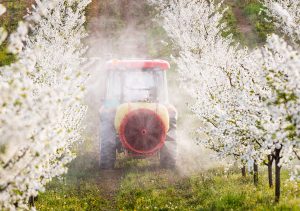
French researchers develop standardised methods for classifying spray deposition and drift-reduction potential. By Anna Mouton.
“Over the past 10 years, we’ve observed a diversification of the sprayer fleet in French orchards,” said Florence Verpont, an engineer at CTIFL (the Interprofessional Technical Center for Fruits and Vegetables), an applied research institution serving French horticulture.
Verpont specialises in crop-protection-product applications. In her presentation at the 2026 Hortgro Technical Symposium, she discussed the Performance Pulvé Arbo (orchard-sprayer performance) project, which aims to help French authorities and growers compare the ever-increasing number of sprayers.
Performance Pulvé Arbo
The Performance Pulvé Arbo project was modelled on the existing Performance Pulvé Viti (vineyard-sprayer performance) project, which standardises testing by using an artificial vineyard as a test bench. Verpont’s goal was to develop a similar test bench for orchard sprayers.
“With Performance Pulvé Viti, they measure product deposition and its distribution within the vegetation, and classify the sprayer based on its potential to reduce the use of plant-protection products,” explained Verpont.
For the orchard equivalent, she considered agronomic and environmental performance indicators. Agronomic performance reflects deposition quantity and distribution, and environmental performance focuses on spray drift.
“We are convinced that spray quality is the key point for optimising the use of plant-protection products from an agronomic and environmental point of view,” said Verpont. “The French national policy encourages the use of high-performance application techniques.”
The Performance Pulvé Arbo project had three steps. First, the researchers designed and constructed an artificial orchard and wind wall. Second, they conducted numerous trials to refine deposition and drift measurement. And third, they validated the methodologies by comparing field and test-bench results.
The artificial orchard
Adjustable wheeled panels simulate the tree rows in the artificial orchard. This allows the researchers to set tree height and width, row width, vegetative stage (early and full canopy), porosity and leaf area index.
Three rows of panels are used when assessing deposition quantity and distribution. The two outer rows represent the surrounding environment, while the central panel in the middle row holds artificial leaves on artificial branches.
“The measurement of spray deposition is done according to ISO 22522,” said Verpont. “We spray a tracer in water, collect the artificial branches, and analyse samples with spectrophotometry.” ISO standards are international.
The data are converted to a normalised unit, defined as the amount of product deposited per unit of leaf surface area to be protected for each gram of product sprayed per hectare. Each branch is analysed separately to generate a deposition profile across the height of the orchard and to calculate deposition uniformity within the tree.
To quantify spray drift, the researchers use two rows of panels and an array of 24 fans to produce wind. The necessary wind speed and direction are stipulated in the standard for drift measurement (ISO 22866), so the test bench includes a weather station.
Drift-collection devices target the various areas of concern: Petri dishes on the ground for soil contamination, PVC wires for aerial drift, and a mannequin in a cotton t-shirt for human exposure.
As for agronomic performance, the drift-collection devices are gathered after spraying, the tracer is extracted with water, and tracer quantities are determined by spectrophotometry. Drift is expressed as a percentage of the applied dose.
Numerous trials confirmed that the results of these methods were similar to those from field trials, were repeatable and reproducible, and could discriminate different settings on the same sprayer.
Agronomic performance
“In France, our reference practice is the axial fan sprayer, which is the most common machine used in orchards,” said Verpont. “Our Ministry of Agriculture initially wanted to know whether the new generation of crossflow sprayers, designed for drift reduction, improves deposition.”
To answer this question, Verpont plotted sprayer performance on a chart with average deposition on the x-axis and uniformity on the y-axis. She established a reference line by plotting the values obtained for various axial fan sprayers.
“This gave us a first threshold of performance, corresponding to the average performance of the axial fan sprayers,” she said. “We could then define other classification thresholds, and the relative position of a sprayer to a threshold reveals its ability to maintain deposition equivalent to the reference level when the dose is reduced.”
Of the sprayers they tested, only 15% reached the first threshold after a 10% dose reduction. A further 15% reached the first threshold without any dose reductions, making them as efficient as the axial fan sprayers, but not candidates for dose reduction.
“Why, in 70% of cases, did crossflow sprayers not reach the level of the reference axial fan sprayers?” asked Verpont.
As corroborated by the test bench, crossflow sprayers struggled with deposition in the upper parts of the trees. “We showed that there’s more difference in spray quality between different settings on the same sprayer than between different sprayer designs,” said Verpont. “The key point is airflow adjustment.”
By adjusting airflow, the researchers could optimise spray distribution in the upper canopy. Going forward, they plan to work with manufacturers to determine standard air settings for improving deposition distribution.
Environmental performance
The test bench produced results similar to field tests for sedimentary (soil-level) drift measurements, but higher values for airborne drift. The method discriminated between sprayers, confirming that crossflow sprayers reduce drift relative to axial fans.
Measuring spray drift indoors with the test bench has advantages. “Indoors, 95% of our trials meet the ISO standard, compared with 45% in the field,” said Verpont. “Stable wind conditions indoors significantly reduce variability.”
Reproducibility indoors is also better than in the field. Temperature and humidity fluctuations can be a problem indoors, especially in summer, when conditions can change significantly from morning to afternoon. However, this can be addressed by including references and performing three test repetitions.
In summary, Performance Pulvé Arbo was proven to be a practical and reliable tool for characterising agronomical and environmental sprayer performance.
“It’s already available to suppliers wishing to test their solution, regardless of their stage of maturity,” said Verpont. “They can test prototypes, products already on the market, or for registration on the official French list of drift-reduction techniques.”
Her group continues to study deposition, particularly on leaves and the ground, and to measure agronomical performance in collaboration with manufacturers. “We are trying to consolidate all this data in a list of equipment that performs well in terms of achieving the reference values,” she concluded.
Crop-sensing-assisted spraying Do gap-detection systems make sense in the South African context? By Anna Mouton. Theoretically, deciduous-fruit growers should be enthusiastic adopters…
Advancements in spray application The key takeaways from the most recent international Workshop on Spray Application and Precision Technology in Fruit Growing. By Anna…
Spray-drift reduction in Europe Fruit growers are subject to increasingly strict drift-reduction regulations. What are their options for compliance? By Anna Mouton. “We need…
Target-adapted dosing and spray application How to optimise crop protection and reduce spray drift through canopy-adapted spray application. By Anna Mouton. “Where do pesticides go…
How are dosages determined? We examine the science behind the numbers. By Anna Mouton. Growers know the dosage rates for chemicals because the numbers…