A recent expansion of the registration of s-abscisic acid unlocks new options for chemical thinning of pears. By Anna Mouton.
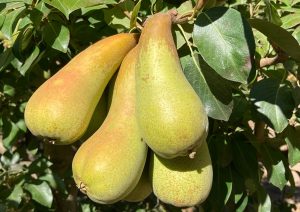
The past season saw the first South African registration of s-abscisic acid (s-ABA) for thinning and increasing fruit mass in Forelle and Abate Fetel pears.
“We initially focused on those cultivars because size and successful thinning are especially important for their profitability,” says Werner Truter, Product Manager at Philagro South Africa, AgroSolutions Division, EMEA Region.
The expanded registration represents the culmination of a decade of local research led by Prof. Karen Theron, then of the Department of Horticultural Sciences at Stellenbosch University. She first evaluated s-ABA in pears in the Warm Bokkeveld and Elgin in the 2015–2016 season.
“At the time, there had been very little research on thinning of pears,” she recalls. “We tested ACC [1-aminocyclopropane-1-carboxylic acid] and s-ABA. Both worked, but s-ABA gave us an additional effect on fruit size.”
The other advantage of s-ABA was that it was already registered for improving colour development in table grapes. Expanding the registration to include thinning and fruit-size improvement in pears was easier than embarking on an entirely new registration.
An interesting compound
Abscisic acid was discovered in 1949 as a growth inhibitor that maintained plant dormancy. Further research found that it also promoted abscission and inhibited germination. Different researchers simultaneously isolated the active compound in 1963. One group, led by Philip Wareing, named it dormin. Another group, led by Fredrick Addicott, called it abscisin II.
The potential of the new hormone was immediately recognised. According to Addicott and his colleague Jessye Lyon, the name abscisin II was “repugnant to commercial interests who hoped that … dormin would become a useful trade name.”
Unfortunately, dormin was already the name of a sleeping pill, so the name abscisic acid, and the acronym ABA, were formalised in 1967. Subsequent research has shown that ABA doesn’t cause abscission directly. Instead, it increases ethylene levels, leading to cell wall degradation in the abscission zone.
As scientists have continued to study ABA, they have revealed its involvement in multiple processes, including seed dormancy and germination, seedling growth, stomatal movement, root development, and the stress response. In plants, ABA is synthesised from carotenoids, primarily in roots and leaves.
Interestingly, ABA is found in everything from cyanobacteria to humans, suggesting that it evolved early in the history of life. Researchers speculate that ABA took on the role of a stress-signalling hormone when organisms colonised land.
Fewer fruit plus more mass
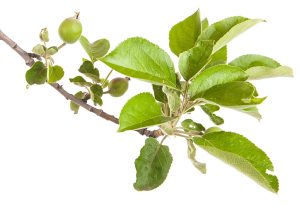
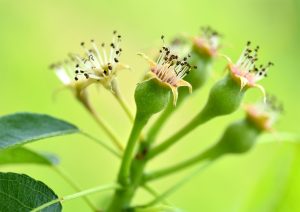
The current s-ABA registration on Forelle and Abate Fetel targets fruitlets with a diameter of 8–10 mm. Truter cautions against earlier applications. “We know from the literature that the chances of over-thinning are greater with smaller fruit, so growers must wait until the average fruit size is 8–10 mm,” he says.
Like most chemical thinners, the effect of s-ABA decreases as fruitlets grow larger, and results from applications after an average fruit size of 10 mm are likely to disappoint.
Thinning due to s-ABA treatment can intensify with higher temperatures and overcast conditions. Truter emphasises that growers must know their orchards and microclimate and consider the weather to achieve the desired outcome.
“When you apply any chemical thinner, you place the tree under stress,” he explains. “Any other concurrent stress factors will increase the thinning effect. For example, you need to be careful when the soil is very wet or if extremely high temperatures are forecast.”
As s-ABA is registered for a range of doses, growers can apply a lower dose if they expect a strong thinning response or want to improve fruit mass without thinning. The effect of s-ABA on fruit mass occurs independently of a lighter crop load.
The absorption of s-ABA is facilitated by slow-drying conditions (cool and humid), so it is best to spray early in the morning or evening. However, don’t apply when the leaves or fruit have water droplets on them or if rain is expected. Rain within six hours of application will dilute the response, and the product cannot be reapplied.
Ideally, maximum temperatures should be at least 18 °C during and for 2–3 days after application. “We know that daily maximum temperatures of 18–27 °C are ideal for thinning,” says Truter. “Anything below 18 °C could reduce the thinning effect, while anything above 27 °C could increase it.”
Although extensive trials demonstrated its safety, s-ABA is occasionally associated with phytotoxicity, characterised by black leaf spots, more so on Forelle than Abate Fetel.
“The majority of leaves aren’t affected, and affected leaves don’t drop. They remain functional, and we haven’t seen any negative impact on the trees,” says Truter. “The fruit are never affected.”
Two modes of action
As mentioned above, ABA raises ethylene levels, apparently by upregulating ACC (an ethylene precursor) synthesis. Additionally, ABA sensitises the abscission zone to ethylene.
Under natural conditions, ABA production can be triggered by sugar starvation in the developing fruitlet, leading to a complex biochemical cascade that amplifies the risk of fruitlet abortion. This is one mechanism by which ABA applications thin fruit.
The hormone also causes stomatal closure, temporarily shutting down photosynthesis, and further increasing nutrient stress for less competitive fruitlets. Stronger fruitlets survive because they produce sufficient auxins to keep their abscission zones intact.
“We think the reason for the increase in fruit size is that, at the 8–10-mm fruitlet stage, when we apply s-ABA, the tree still depends on reserves transported from the roots in the xylem, primarily to the leaves,” says Theron. “By closing the stomata, the transpiration stream is diverted to the fruitlets.”
However, she is quick to add that more research is needed to understand fully how different mechanisms contribute to ABA’s effects.
Even though scientists have studied ABA intensively for nearly 70 years, they are still making discoveries. For example, a team from the United States presented work at the 2025 ISHS Symposium on Plant Regulators showing that a combination of synthetic auxins and ABA could significantly reduce bitter pit in Honeycrisp apples.
Here in South Africa, trials with s-ABA continue on other cultivars, according to Truter. “As the fruit industry develops, Philagro South Africa must also adapt to meet the growers’ needs,” he says.
Related Posts:
Fruit size The principles and practices affecting pome- and stone-fruit development throughout the year. By Anna Mouton. “There will never be an…
Buchuland Christo Strydom of specialist pear-packhouse Wolfpack and Buchuland production manager Henk Rossouw discuss two top-performing pear orchards. By Anna Mouton.…
Research rundown A summary of past and present Hortgro-funded Forelle research not covered elsewhere in this issue. Hortgro-funded work on other pear…
ACC The newly registered 1-aminocyclopropane-1-carboxylic acid (ACC) increases the scope for late thinning of apples. By Anna Mouton. “ACC became available…
Thinning 101 Understanding natural fruit drop is essential for successful chemical thinning. By Anna Mouton. Chemical thinning to remove surplus flowers and…
Getting to the root of salt tolerance Which stone-fruit rootstock is best for brackish conditions? By Anna Mouton. A new project funded by Hortgro will determine the…