A new research project explores how temperature influences apple size from bud development to harvest. By Ilyaas Rhoda.
Fruit size remains an important factor in apple production, directly influencing market value, export potential, and overall profitability. Although growers rely on practices such as pruning and thinning to manage fruit size, temperature plays a major role throughout fruit development.
A new Hortgro-funded project, led by Dr Esmé Louw of the Department of Horticultural Science at Stellenbosch University, aims to provide a clear, evidence-based understanding of how temperature influences apple fruit size.
“While temperature is widely acknowledged as an important factor, its precise role across different climatic regions and developmental stages is not fully understood at a practical level,” says Portia Solomon, the doctoral student on the project.
“This study seeks to close that gap by identifying when and how temperature has the greatest impact, and how these effects differ between cooler, moderate, and warmer production areas.”
Bud development is foundational
The study is expected to confirm that bud development in the previous season is critical for fruit size, so Solomon will track bud anatomy and quality from bud formation to bud burst, and link her findings with temperatures and final fruit size.
“During bud development, cells form through division, and the number of these cells lays the foundation for the ultimate fruit size,” says Solomon. “As the season progresses and fruit sets, growth shifts mainly to cell expansion rather than new cell formation.”
Climatic conditions during early development are likely to have a lasting impact on fruit size. Cooler and more stable conditions are better for cell division, while warmer conditions may accelerate development, reducing the time for cell division.
In addition to growing-season temperatures, the study will consider the influence of autumn and winter temperatures. Winter chill (the accumulation of cold temperatures that trees need during dormancy to ensure normal and uniform bud break in spring) is a key factor.
“Adequate winter chill and favourable autumn conditions support better early cell development within the bud, which ultimately contributes to improved fruit size at harvest,” explains Solomon.
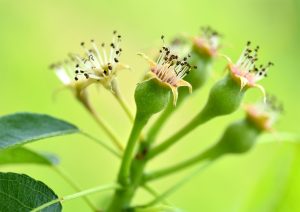
While her focus is on bud development, she will also investigate the role of flower quality in determining final fruit size.
Differences between flowers within the same cluster, such as king and lateral flowers, may influence how fruit develops, so Solomon will monitor king and lateral fruitlet growth weekly until harvest. Understanding this progression from bud to flower to fruit will provide a complete picture of how temperature affects development.
Temperatures and timing
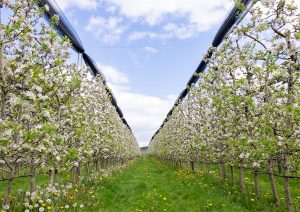
The field work will take place across three production regions with different temperature profiles (Grabouw, Villiersdorp, and Ceres). By including these regions, the study aims to define how and to what extent temperatures influence development and final fruit size.
“A key aspect of the research will be identifying the stages of development where temperature has a significant influence,” says Solomon. “The period before bud break is expected to be particularly critical, as this is when rapid development of the final appendages, such as pollen sacs and ovule primordia of the flower, takes place.”
Similarly, the few weeks after bloom are crucial as this is when cell division occurs in the fruitlet.
Solomon will sample buds from different bearing positions: terminal buds on short shoots, 1-year-old spurs, and 2-year-old (or older) spurs, across 20 trees each of three cultivars (low, medium, and high chill). To ensure objectivity, trees will be randomly selected each week.
“To count the cells, the sample tissue will be viewed under a light microscope in conjunction with imaging software, and with a scanning electron microscope,” states Solomon. “However, the laboratory protocol is currently in a trial phase with a new bud dehydration and embedding technique set for testing.”
Correlating early bud development to final fruit size will be challenging, admits Solomon. “While the cells are counted from buds, flowers, and fruitlets collected within the different orchards, these samples are removed from the trees,” she says. “Therefore, they cannot be tracked as they grow into fruit.”
Additionally, the grower’s crop load management and fruit-thinning strategy will affect whether a bud reaches its full potential in terms of fruit size.
Seasonal shifts affect fruit size
The research will further examine how seasonal temperature patterns influence fruit development. Early warm spells, delayed cold periods, or heatwaves can affect key growth stages, particularly when extreme conditions persist. These patterns may differ between regions and contribute to yearly variation in fruit size, even within the same orchard.
“Factors such as crop load, pruning, and water availability will still play a key role in determining final fruit size,” notes Solomon. “For instance, a high fruit load can limit size due to competition for resources, even under favourable conditions.”
Solomon will obtain fruit-size distribution curves from pack houses in Grabouw, Villiersdorp, and Ceres, as well as data from weather stations, and attempt to model the relationship between fruit size and temperature using machine learning.
“Models can assist growers in estimating fruit size earlier in the season, providing valuable information for harvest planning and marketing decisions,” says Solomon. “While such models may not be fully developed within the scope of this study, our work is expected to form a useful starting point for future research and industry application.”
By comparing different climatic zones and combining field observations with laboratory analysis, she seeks to identify where key differences occur and how they affect outcomes.
Solomon expects that cooler, more stable conditions during early development generally support larger fruit. “Warmer conditions may restrict size if not properly managed,” she says. “Rather than viewing temperature as simply positive or negative, the study will examine its effects across different developmental stages in more detail.”
Related Posts:
Fruit size The principles and practices affecting pome- and stone-fruit development throughout the year. By Anna Mouton. “There will never be an…
Research rundown A summary of past and present Hortgro-funded Forelle research not covered elsewhere in this issue. Hortgro-funded work on other pear…
Thinning 101 Understanding natural fruit drop is essential for successful chemical thinning. By Anna Mouton. Chemical thinning to remove surplus flowers and…
Comparing apples with apples Why is there so much variability? By Anna Mouton. Inconsistent fruit quality and ripening is the bane of apple growers…
Predicting bud-break Do chill units tell us anything? By Anna Mouton. The idea behind chill models is to figure out what trees…
Dormancy and rest-breaking basics Rest-breaking agents are indispensable in mild winter regions, but their limitations must be heeded. By Jenny Underhill. Deciduous fruit trees…