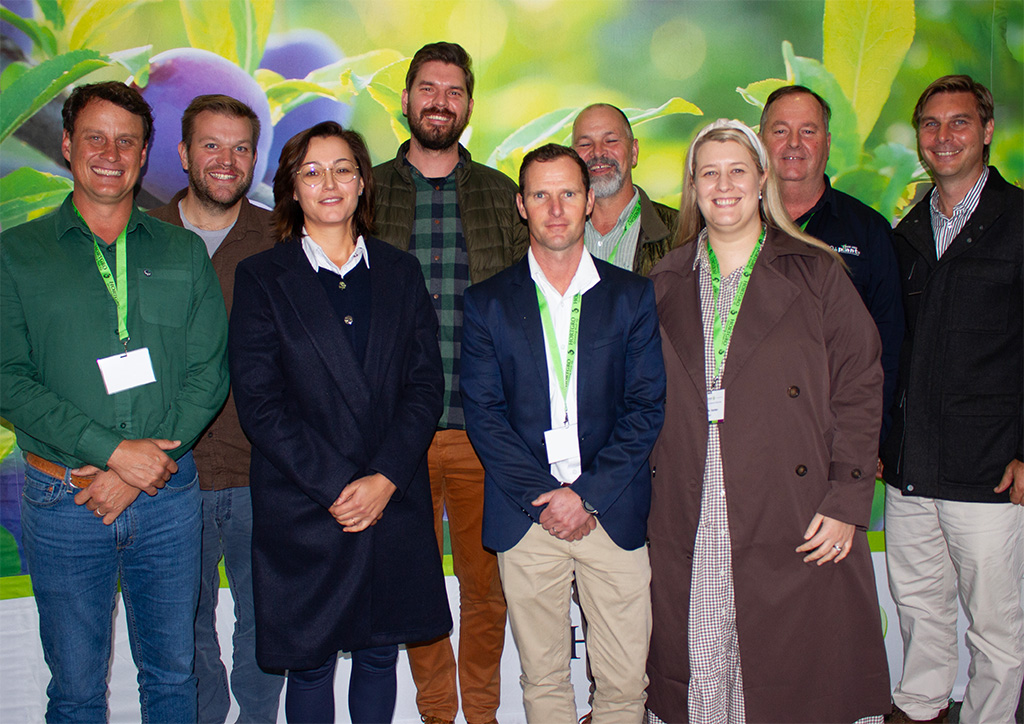
Left to right: Willie Kotze, Nic Finger, Angelique Pretorius, Tristan Dorfling, Johan Visser, Wiehann Steyn, Minette Karsten, Frederik Voigt, Nelius Kapp.
Industry experts share their take on M.9 versus G.778, where to plant what, and other factors influencing orchard success. By Anna Mouton.
The crop-production panel discussion at the 2026 Hortgro Technical Symposium focused on an evergreen topic: apple rootstocks. To set the scene, panel chair Dr Wiehann Steyn, General Manager of Hortgro Science, summarised the evolution in rootstock preferences over recent decades.
“In 2011, trees were mostly on M.793,” he said. “If you add M.7 and MM.109, those three represent close to 100% of the rootstocks planted. But by 2016, M.793 was in dramatic decline, M.7 and MM.109 had increased, and small numbers of M.9 and G.778 were coming through.”
During this period, the Orchard of the Future project demonstrated that M.9 worked in South Africa. “So, we expected an increase in dwarfing rootstocks,” said Steyn, “but that’s not what we saw.”
In 2025, only 16% of rootstocks planted were M.9. The highly vigorous G.778 was the most popular, at 34%, followed by M.7 (20%). The relatively new G.890 accounted for 10%, and MM.109 had dropped to 8%.
To understand these changes and how technical advisers think about rootstocks, Steyn turned to a panel of four industry experts: Nelius Kapp (Soil2Root), Willie Kotze (Dutoit Agri), Angelique Pretorius (Kromco), and Frederik Voigt (ZZ2).
This article highlights key points from the discussion. The full session is available on the Hortgro YouTube channel.
Q. Why is Dutoit Agri increasingly planting M.9?
Willie Kotze
We want to change the type of fruit we produce. Our goal is a specific number of Class-1 cartons of highly coloured fruit per hectare every year, with consistent, targeted fruit sizes. We also want to decrease labour demand during harvest time because it allows us to pick fruit with uniform size and colour at the right maturity.
For that, we needed a narrower canopy on a more dwarfing, precocious rootstock, especially as we want to plant under nets. It’s very difficult to achieve consistency if you must fight vigour. We needed a rootstock that gives us consistent bud quality throughout the tree.
M.9 ticked most of the boxes for us. We are exploring some of the more dwarfing Geneva rootstocks, such as G.202 and G.757. There are also some Geneva rootstocks in the M.7 vigour class that might have potential in weaker soils. As time passes, we will slowly trial some of those, but for now, our focus is on M.9.
Q. Kromco growers are planting both M.9 and G.778. What is the thinking behind this?
Angelique Pretorius
I’ve looked up the data for the past four years, and 55% of our growers’ plantings are on G.778. Secondly, 25% is on M.9, and our third largest is still M.7 at 10%. Then there’s 5% G.228 and 5% G.890.
We have two groups of growers. The first is on third-generation replant soils. They don’t want to struggle with growth because then they don’t achieve the necessary cumulative tonnes, so they would rather fight vigour.
Growers in the second group want to simplify the trees, drive productivity, and enable mechanisation. Simpler trees and more uniform fruit are also more labour-friendly.
Some of our growers are also looking at terroir and soil potential. We’ve learned not to plant G.778 at 3.5 x 1.25 metres on a medium-potential apple soil in Grabouw with a Granny Smith or Lady in Red scion. You will not slow it down with crop load.
On medium-potential soils, some growers will rather plant G.778 at 1.5 metres. Or, on a cooler, southern slope, they might plant M.9.
Q. Does the cost of trees affect the uptake of dwarfing Geneva rootstocks?
Frederik Voigt
A high-density system can require an additional investment of R250 000 to R325 000 per hectare. This includes the cost of additional trees, tissue-cultured rootstocks, and royalties or levies for rootstock and scion cultivars.
For context, at a planting density of 3.5 x 1.0 metres, the Geneva rootstock royalty alone amounts to approximately R86 000 per hectare, while the tissue-culture premium may account for approximately R80 000 per hectare.
This is a substantial capital investment, but when managed well, growers benefit from earlier production, larger fruit, better pack-outs, and faster returns on investment.
Q. What can go wrong with dwarfing rootstocks?
Willie Kotze
We’ve planted most of the M.9s on our highest-potential soils, and most have become too vigorous. We’ve started to use prohexadione-calcium on most of them. As we gain more experience, we’ll roll out M.9 to medium-potential soils because we’re learning how to manage it.
So, we’re becoming less and less concerned about issues with M.9. If we get good plant material, I think there’s little risk, especially if we plant it in very narrow rows.
Q. What are the problems with vigorous rootstocks?
Angelique Pretorius
We are in a honeymoon phase with G.778. We’ve achieved amazing results thanks to good plant material. For example, we have Bingo Gala orchards planted at 3.5 x 1.25 metres, averaging 420 tonnes cumulative yield by fifth leaf, and we still have vigour in the tops. The trees get no nitrogen in summer, only postharvest nitrogen in autumn.
We are pruning later and later, doing hedge cutting in November or even in autumn. If you don’t have a hedge cutter, you’ll need to prune by hand. We are considering girdling, and we are using plant growth regulators.
So, I see a lot of work ahead. If we want to reduce input costs and labour, I don’t think this is where we want to be.
Q. How do the site characteristics affect rootstock choice?
Nelius Kapp
I move between a lot of different production environments, and you can clearly see that rootstocks behave differently in different climates and on different soils.
For example, the Eastern Free State, which is a summer-rainfall area, is a very vigorous area. And the Koue Bokkeveld has good winter chilling, so you generally don’t struggle to make a tree there, while in the EGVV, which has marginal winter chill, you do generally struggle.
Now, consider different rootstocks in those different environments. In the Eastern Free State, you won’t even consider G.778 because it will be extremely vigorous. Even M.7 is considered too vigorous there, and M.9 is the standard.
In the Koue Bokkeveld, you have a greater chance of success with a dwarfing rootstock like M.9, but it is site-specific. There are sites with raw shales in the Koue Bokkeveld where you need a more vigorous rootstock. But something like M.9 can do particularly well on sites with fine sandy loams with a good clay fraction.
M.7 makes good trees in the Ceres area, but results are variable in the EGVV. M.9 is seen as risky in the EGVV. G.778 remains vigorous, but it is very adaptable. It has the widest adaptability I’ve seen, even on very marginal soils, for example, 80% or more rock, gravelly soils with very low clay fractions, and white, sandy soils.
I’m not saying you can’t plant M.9 in a certain area, or that G.778 is wrong. Growers understand farming, and they can make a second-best option work. But there are obvious scenarios that will lead to failure. For instance, it’s a very bad idea to plant M.9 in sandy soil on top of an exposed hill in Grabouw.
Q. What is nursery-tree quality, and what happens when growers plant poor-quality trees?
Frederik Voigt
Nursery-tree quality includes the physical quality, which includes tree size and reserve status, and the physiological quality, which includes whether the tree is hardened off well. The trees must also be virus-free, so they must preferably be certified.
In a high-density orchard on a dwarfing rootstock, there is very little margin for error. Planting on a low-potential or unsuitable site already increases the risk of poor establishment, and using a substandard nursery tree further increases that risk. If a weak tree on M.9 must subsequently be cut back or stem-renewed, its canopy development and early production can be further delayed.
Willie Kotze
In my opinion, planting a substandard tree in an intensive system is probably one of the worst things that you can do.
In an intensive system, you want early yields of Class-1 fruit that you can put into premium markets and that keep well during shipping. When you plant small trees, you end up pushing them with nitrogen to get to the top wire, and the more dwarfing the rootstock is, the harder and longer you’re going to push.
So, one of two things happens. On a more vigorous rootstock, when the tree eventually fills its space by the third leaf, you’ll probably start slowing down the nitrogen. But you’ll have a residual effect that will carry over into the next two or three years. You will have fruit that colours later, probably doesn’t keep as well, and develops postharvest disorders.
On a more dwarfing rootstock, if you start cropping before you fill the space, you will continue applying nitrogen. This delays your breakeven because you must sell that fruit into a lower-risk market. Also, you have oversized or poorly coloured fruit.
Nelius Kapp
When you apply nitrogen, the effect doesn’t stop when you stop. It’s built into the reserves, and it carries over for a couple of seasons. When you see in year two that you’re filling your space or the tree is running, stop applying nitrogen immediately. We want to prevent the negative effects of prolonged nitrogen that manifests over time. A tree is not a switch you turn on and off by giving it fertiliser or not.
Also, in higher-density orchards, when you take a gram-per-tree approach, you end up applying a lot more nitrogen on a kilogram-per-hectare basis compared to 4 x 1.5 or 4 x 1.75-metre plantings when the trees start cropping. So, I’m adopting a kilogram-per-hectare approach and allowing the trees’ vigour to guide me.
Q. In 2025, 53% of nursery trees were uncertified. Does this matter in practice?
Frederik Voigt
There can be several reasons why plant material is uncertified, and it does not necessarily mean it is poor quality or virus-infected. Certification may be affected by administrative factors or by a new variety not yet appearing on the official varietal list. Nevertheless, the industry should aim to increase the percentage of certified trees.
Certification becomes increasingly important in high-density orchards on dwarfing rootstocks where there is less tolerance for weak or uneven growth. Latent viruses may affect nursery-tree quality, establishment, uniformity, and longer-term orchard performance, even when obvious symptoms are absent.
We have also observed poor bud take or graft compatibility in nurseries, particularly in certain combinations involving virus-infected scion material and Geneva rootstocks.
Angelique Pretorius
The Scheme doesn’t only certify for viruses. It also ensures traceability. If an exotic virus comes in, and most of our trees are outside the Scheme, how are we going to trace it? We saw the importance of traceability with plum marbling.
In the EGVV, we’ve had plantings in the past three seasons where the growers didn’t receive the trees they ordered. One planted Lady in Red. He ordered G.778, but he received M.9. Another grower planted Cripps Red and RDS. He ordered G.778 and received G.202. Those trees were outside the Scheme.
Q. What future rootstock developments do you envisage?
Frederik Voigt
I think we are seeing a major transition in the nursery industry. Traditionally, growers had a relatively limited choice of stool-bed-propagated rootstocks and standard whip trees. Increasingly, they will be able to select not only the most appropriate rootstock, but also different tree types, including containerised, feathered, and multi-leader trees, to suit their orchard system.
Tissue culture has been a game changer. South African trials in the early 2000s already demonstrated the potential and precocity of G.778 and other Geneva rootstocks. However, commercial adoption remained limited because traditional propagation systems struggled to produce them at a sufficient scale. Tissue culture largely resolved this constraint.
In 2020, only about 4% of South African apple nursery trees were produced on tissue-cultured rootstocks. By 2025, this had increased to 45%. This rapid transition is improving growers’ access to a wider range of rootstocks and increasing their ability to select the best fit for the site and orchard system.
Nelius Kapp
I believe there will be rootstocks ranging from vigorous to dwarfing, reflecting the varying microclimates, soil, and management styles. I don’t think there should be a dominant rootstock.
Angelique Pretorius
I think we will still have all three vigour classes. There will still be G.778 and maybe M.9. I foresee we will have more G.228 in our group. It’s a very difficult rootstock for the nursery but excellent for growers.
I hope we’ll have more G.202 because we have some exceptional orchards on it. And then we need something in the same class as M.7.
Willie Kotze
I think our goal should be calm canopies. We need narrower plantings and canopies with more uniform fruit quality and size, and more consistency.
A final comment on rootstocks and canopy systems: We’ve seen many plantings where the rootstock is correct, but the canopy is poorly managed. It’s still too vigorous. It’s still overcropped. Fruit quality is bad on the inside of the tree, fruit at the base still doesn’t colour, and if the tree is overcropped, fruit size and return bloom are inconsistent.
So, the system management is as important as the rootstock. It’s very important to remember that good rootstock genetics are not a get-out-of-jail-free card.
Research rundown A summary of Hortgro-funded apple-rootstock research projects. By Anna Mouton. Rootstock research at Hortgro Science includes evaluation trials and horticultural…
South African apple-rootstock trends The industry has come a long way since M.793 ruled the roots. Three technical advisers discuss the journey and where…
Fit for purpose South African apple growers are leveraging rootstock diversity to adapt and thrive in an increasingly complex industry. By Anna Mouton.…
Apple rootstock tables A quick rootstock reference guide for South African growers that includes the results of local evaluation trials. Notes Varieties marked…
Can dwarfing rootstocks cope with drought? A Hortgro-funded project assessed the response of new and popular apple rootstocks to deficit irrigation. By Anna Mouton. Dwarfing rootstocks…