No new technology is fit for every situation. How can growers decide what to implement? By Anna Mouton.
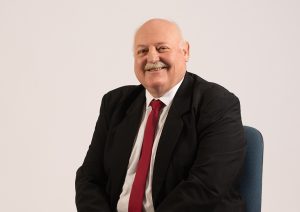
“I’m going to define technology as a tool or technique that increases efficiency or productivity, reduces uncertainty or helps manage risk, or makes the impossible achievable,” said Nic Finger.
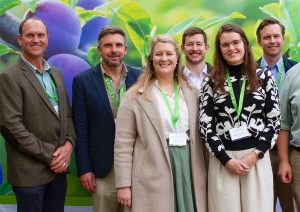
Finger is the Industry Services Manager: Grower Development and Trials at Apple and Pear Australia Limited. He is also the founder and principal consultant at specialist horticultural consultancy Fruit Help.
At the 2026 Hortgro Technical Symposium, he laid out a framework for thinking about technology adoption, including a brief lesson in economics.
The fruit has to pay
Innovations may be cool, but that’s not a reason to embrace them. “We must remember that orchards are businesses,” said Finger. “We can’t just implement every technology tomorrow. We’ll run out of money.”
The first question a grower should address is: why? “Without a reason, a new technology might waste your time, your money, or both,” commented Finger.
Technologies are rarely plug-and-play. Growers must interrogate whether something fits their system. If they need to upskill their team, they need to ensure training and support are available. Oftentimes, implementation requires a champion who believes in the technology, commits to its success, and convinces others to buy in.
“One of the big challenges is that people must want the technology and understand its benefits,” said Finger. “If people decide something won’t work, they’ll make sure it fails. It’s human psychology.”
Besides ticking these boxes, a technology must show a clear return on investment. It must contribute to the ultimate goal of producing and selling high-quality fruit. “Eventually, the fruit pays for everything,” said Finger. “If there’s no fruit, there’s no money.”
Two case studies
Finger used two case studies to illustrate how growers should evaluate new technologies. The first is a simple girdling scissor, used to notch or score the trunk, inducing breaks below the notch. Girdling scissors are a potential solution to blind wood in the lower canopy. They are inexpensive and easy to put into practice.
“How do we justify this technique?” asked Finger. “We can increase canopy fill by 10% over two years, thereby increasing our yields and income for the next 10 years. So, it’s a pretty straightforward decision.”
His second case study involves a machine vision system called Green Atlas Cartographer. “Data collection in the orchard can be super intensive,” he said. For example, counting plum blossoms to inform thinning actions is time-sensitive and tedious.
The machine vision system can count faster than humans and doesn’t fatigue. Because it collects data over a larger area, it improves accuracy. It can map several variables, including flower and fruitlet density, canopy density, and fruit size and colour.
Useful though the Green Atlas Cartographer appears, each grower still needs to examine its value proposition for their own context. For example, the system can enable more accurate thinning, but it doesn’t reduce the time and cost of chemical or manual thinning. Therefore, growers need to determine whether the potential gain in accuracy justifies the cost.
“Businesses have unique challenges, risk tolerances, management, and context,” said Finger. “I’m going to keep using that word: context.”
For example, sometimes technologies only make financial sense at a particular scale. “Take leaf blowers,” he said. “You need to know your context — whether you have the scale to justify the capital investment, and whether the payback period works for the investor.”
Crunch the numbers
Growers can use a cost-benefit analysis to assess potential investments in technology. Finger walked the audience through five components of this process: realistic data, additional costs, additional benefits, financing costs, and net cash flow.
“We want to gather data that builds the assumptions that feed into our analysis,” he said. “Your assumptions need to be sound. If you’re lying to yourself, it will hurt you or whoever your investor is.”
Financing costs include loans, fees, and interest, and additional costs result from implementing the technology. For example, if growers decide to use girdling scissors, they need to buy the scissors, train their workers, and pay for the labour to notch the trees.
Cost savings or higher returns fall under additional benefits. “Income generally trumps costs,” said Finger. “Chase the income.”
All this information feeds into a net cash flow model. Finger demonstrated how to draw up a net cash flow model using reflective mulch as an example.
The assumptions underlying the model include the capital expenditure (mulch fabric, hooks, and hook installation), the lifetime of the reflective mulch, labour rate (for placing and removing the mulch seasonally), financing costs, inflation rates, orchard yield (cartons per hectare), added value per carton, and discount rate.
The discount rate allows growers to estimate the present value of the expected future income. The rationale for discounting future returns is that a rand today is worth more than a rand ten years from now. This is partly because a rand invested today will (hopefully) generate a positive return over the next ten years.
Cost, benefit, and sensitivity
Once a cost-benefit model has been set up, it can be tweaked to examine different scenarios. Finger started with a scenario in which the reflective mulch is used on a single cultivar for five seasons, and it improves Class-1 pack-outs by 5%.
He then compared this to a scenario where the same fabric is used twice per season (on different cultivars). In this case, the additional costs increase because the hooks must be installed and the fabric placed and removed in two orchards.
However, by using the fabric in two orchards instead of one, break-even occurs in year 1 rather than year 3.
“Fortunately, with AI, you can put all your assumptions in a prompt and ask it to build you scenarios,” said Finger. For example, what happens when pack-outs improve by only 2%? What happens if pack-outs improve by 12%? Or how is the cash flow affected if the reflective mulch only lasts three years, not five?
Tabulating the expected net cash flow for the different values of the input variables provides a sensitivity analysis that highlights variables with large effects on the return. Growers can also use net cash flow models to compare the returns of investing in different technologies.
“I was meant to talk about technology, and I gave an economics lesson,” joked Finger. “But you must consider the financial analysis, even if it’s on the back of an envelope at the pub. Or use AI. It’s a handy tool that makes things very quick.”
To conclude, he referred to the Symposium theme: Growing forward in a changing world. “If you don’t move forward, you will go backwards,” he said. “So, you want to work with the best technology.”
Planting for profitability Key pointers for establishing and managing high-performing orchards. By Anna Mouton. “We need to chase profitability,” said Nic Finger. “Not…
Fit for purpose South African apple growers are leveraging rootstock diversity to adapt and thrive in an increasingly complex industry. By Anna Mouton.…
Case study: effective plant improvement The Netherlands is a small country that packs a powerful horticultural punch —can the South African pome- and stone-fruit industries…
Hot topics in crop protection From regulations and research to integrated and regenerative practices. By Anna Mouton. “How will the deciduous-fruit industry transition to more…
What is Hortgro’s plan going forward? Anton Rabe, Executive Director of Hortgro, addressed the Hortgro Technical Symposium in a pre-recorded message. By Kara van der Berg.…
Research rundown A summary of Hortgro-funded apple-rootstock research projects. By Anna Mouton. Rootstock research at Hortgro Science includes evaluation trials and horticultural…