How to optimise crop protection and reduce spray drift through canopy-adapted spray application. By Anna Mouton.
“Where do pesticides go when the droplets have left the nozzle?” asked Dr Peter Triloff, addressing the audience at the 2026 Hortgro Technical Symposium. With more than 35 years of experience in crop protection and spray application, Triloff knows that only 20%–55% of the applied pesticide typically reaches the target.
“If you do a good job, you can deposit 2.8 times more pesticide on the tree than if you do a bad job,” he said. He presented data showing that 2%–5% of the applied pesticide drifts outside the orchard, 4%–6% evaporates, and 30%–70% lands on the orchard floor.
Triloff outlined the three steps of what he calls AOS (AirCheck-Optimized Spraying). First, improve spray application to maximise deposition quantity and quality. Second, adjust the pesticide dose to the spray application technique and canopy. Third, reduce remaining spray drift without compromising steps one and two.
Fans are not created equal
Effective spray applications start with the right fan, but growers have a superabundance of options. How can they know what is best for their situation? Triloff explained that fans must be judged on their vertical air and liquid distribution, as measured on air and liquid test benches.
“The fan is not an air force,” he emphasised. “In the past, fans were built for power. To improve efficiency, we need them built for distribution.”
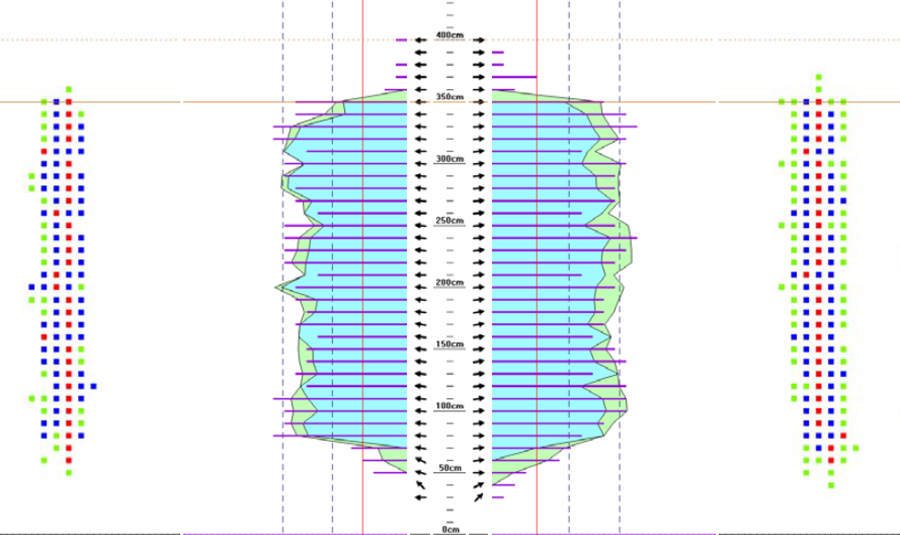
Ideally, the air distribution should be rectangular (Figure 1: Top). This allows growers to control the horizontal reach by adjusting the forward speed and fan speed without affecting the fan’s working height. When the air distribution is triangular (Figure 1: Bottom), the airflow is excessive at the bottom and insufficient at the top.
Figure 1: The air distribution of two fans. The blue area represents usable airflow with sufficient velocity, while the green area represents air that will not reach the canopy because of too-low velocity. The dotted areas represent the airflow at the target (green is unusable, blue is usable, and red is maximal). Source: Dr Peter Triloff | AirCheck.
For a full interpretation of these figures, visit the AirCheck website.
Caption
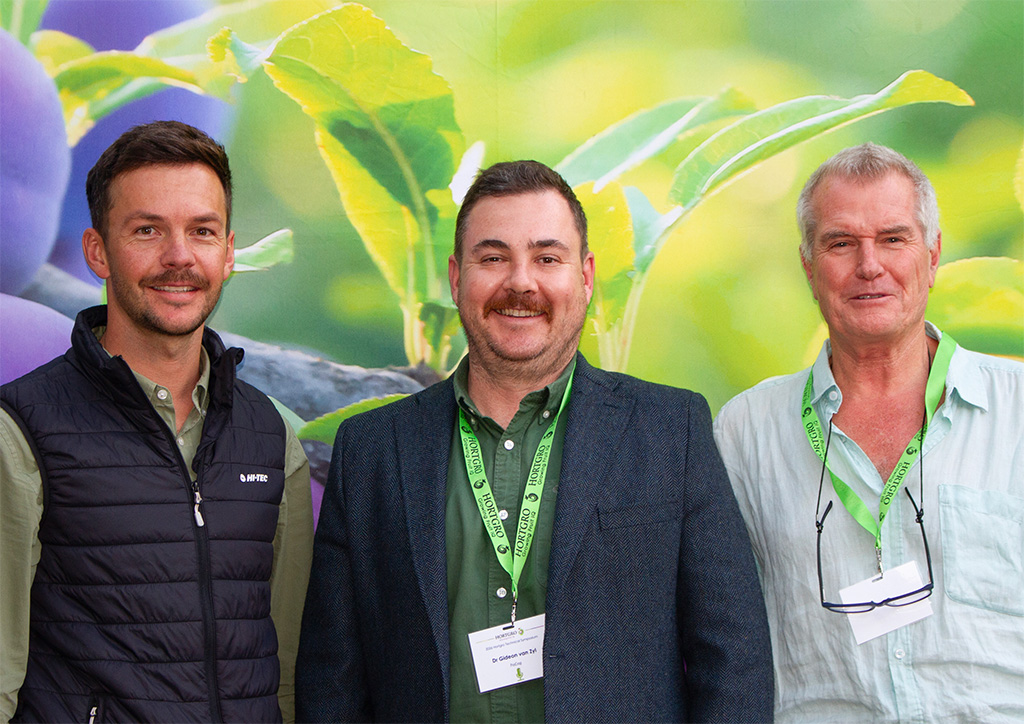
Left to right: Philip Rebel, Dr Gideon van Zyl, and Dr Peter Triloff.
Caption
Left to right: Philip Rebel, Dr Gideon van Zyl, and Dr Peter Triloff.
“With triangular air distribution, if you reduce fan speed, you reduce working height,” said Triloff. “If you increase fan speed, you spray beyond the top of the tree and at the bottom, you spray at least two rows.”
Most crossflow fans carry a hidden axial fan in the top of the tower. Consequently, the angle of airflow from the top nozzles can approach 60°, again resulting in an unsatisfactory compromise between working height and air velocity.
“If we have horizontal air distribution, we can play with the reach, but then the angle of the airflow must be less than 30°,” said Triloff.
When air travels at a steep angle to reach the tops of trees, deposition on upper leaf surfaces is reduced, and pest and disease risk increases. Matching air distribution to tree height at a low angle is essential for achieving more uniform spray deposition on upper and lower leaf surfaces throughout the canopy.
For 3-metre-wide rows, the maximum tree height that can be sprayed with a low-angle airflow is 3.5 metres. Taller fans are impractical because the towers are liable to bump into the trees when the orchard floor is uneven. Therefore, growers should think about spray applications when designing their orchards.
“Tall crops need tall fans, or these crops must become smaller,” said Triloff. “There’s no other solution.”
In addition to fan type, deposition quantity and quality are determined by forward speed and fan speed. In Triloff’s native Germany, the official maximum forward speed in orchards is 6 kph.
“This is too fast for wide canopies and way too slow for very slim trees,” he said.
Triloff recommends adapting forward speed and fan speed to canopy width. This causes the airflow to bend inside the canopy (and droplets will remain within it). In narrower canopies, it improves deposition and reduces water and pesticide use.
Besides improving deposition, increased forward speed increases work rate and driver safety (by reducing potential exposure time), and reduces spray drift, fuel consumption, labour costs, and noise.
The AirCheck whitelist
“If you ask a dealer, what can you tell me about the fan you want to sell me, he can tell you its power consumption, the airflow it produces, its colour, and probably whether your neighbour has it — that’s how you know it’s a good fan,” quipped Triloff. “But that’s about all.”
To remedy the lack of independent, relevant information on fan performance, Triloff developed AirCheck, a certification scheme based on standardised testing.
AirCheck publishes a whitelist of certified fans, including metrics such as maximum working height at a 3-metre row width, maximum airflow angle, usable airflow per metre of working height, energy efficiency, noise emission, and drift-reduction classification.
Growers can enter their orchard details, including row width, tree height, terrace height, and slope, on the AirCheck website to find the best fan options for their needs. The system can provide the manufacturer with specifications for adjusting air and liquid distribution to suit that grower.
AirCheck-Optimized Spraying
AirCheck-Optimized Spraying is a two-part system that includes individually AirCheck-certified sprayers and a dosing model to improve deposition and reduce spray drift, fuel consumption, and noise emissions.
In trials using a crossflow fan, canopy-adapted fan speed, and a mixed nozzle set (hollow-cone nozzles plus two air-induction nozzles at the top), spray drift was reduced by 85%. Add protective netting, and the drift is reduced by 90%.
“When we added airflow control to the fan and an active air-deflection system, we got 90%–95% drift reduction despite using a full set of hollow-cone nozzles,” said Triloff.
The AOS43 dosing model uses a preset spray liquid pressure and adjusts water volume, pesticide dose, forward speed, and fan speed based on canopy width. When canopy width decreases, forward speed increases and fan speed decreases, and vice versa.
“In very slim canopies, we can double the work rate compared to normal spraying,” said Triloff. With the AOS system, water and pesticide use per hectare is about 51% less than with conventional spraying.
Additionally, AOS outperformed or equalled conventional spraying for scab control in 75% of orchards tested across seven commercial orchards over three years.
Overall, the case for target-adapted dosing and spray applications is convincing. Not only do growers use less time, labour, and cost, but systems such as AOS help them to protect their crops with a shrinking pesticide arsenal.
“Like us, you are losing active ingredients. In a few years, we will probably be forbidden to spray water,” joked Triloff.
However, he added a serious message for growers. “The substitutes for withdrawn products increasingly show reduced efficacy. In that situation, we can’t afford homemade problems because our air distribution doesn’t match our trees.”
Spray-drift reduction in Europe Fruit growers are subject to increasingly strict drift-reduction regulations. What are their options for compliance? By Anna Mouton. “We need…
Advancements in spray application The key takeaways from the most recent international Workshop on Spray Application and Precision Technology in Fruit Growing. By Anna…
A new assessment tool for orchard sprayers French researchers develop standardised methods for classifying spray deposition and drift-reduction potential. By Anna Mouton. “Over the past 10 years,…
Hot topics in crop protection From regulations and research to integrated and regenerative practices. By Anna Mouton. “How will the deciduous-fruit industry transition to more…
Crop-sensing-assisted spraying Do gap-detection systems make sense in the South African context? By Anna Mouton. Theoretically, deciduous-fruit growers should be enthusiastic adopters…