Key pointers for establishing and managing high-performing orchards. By Anna Mouton.
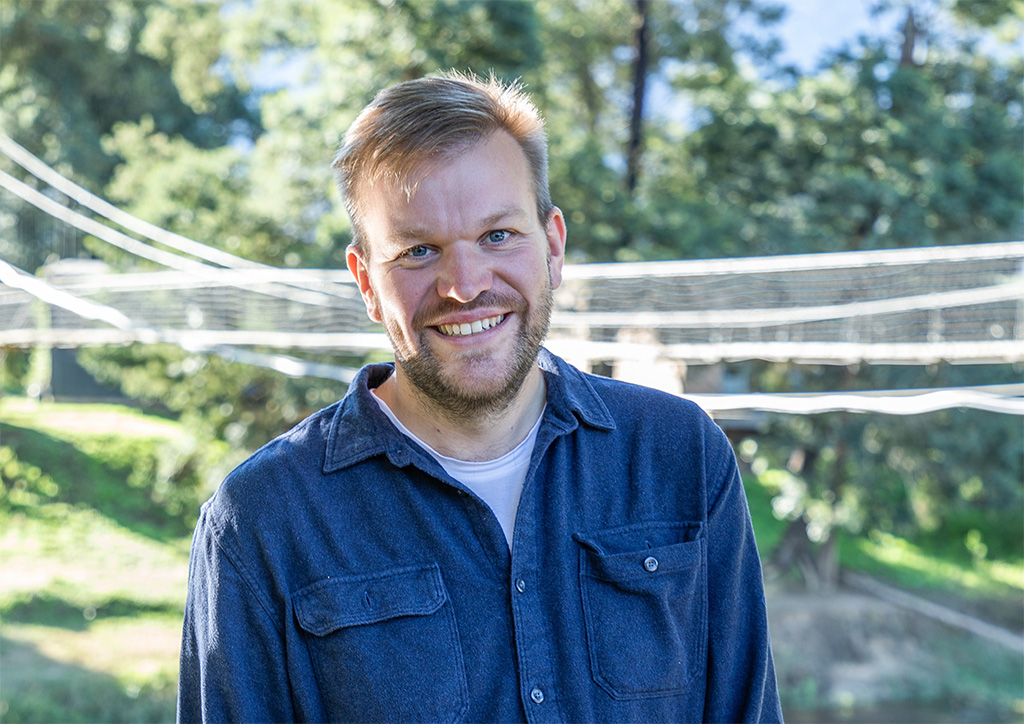
“We need to chase profitability,” said Nic Finger. “Not in a single year, but we must make money over the lifetime of the orchard. How to do that will be different for everyone, and it changes over time.”
Finger is part of the seventh generation of a farming family and has been a technical adviser for more than a decade. He is also the Industry Services Manager: Grower Development and Trials at Apple and Pear Australia Limited.
Speaking at the 2026 Hortgro Technical Symposium, he shared his perspective on planting systems, the risks and rewards of intensification, and why passion is essential for success.
Why are planting systems changing?
The main trends in orchard systems over the past 60–70 years have been higher planting densities and narrower tree canopies. Management tools such as precision irrigation and fertilisation have enhanced efficiency gained from better light interception and distribution, earlier and higher yields, and labour-friendly trees.
“By streamlining our resource use, we don’t necessarily reduce the overall production cost, but we lower the cost per unit of fruit,” said Finger.
He stressed that growers should optimise income. “Maximise the income per unit input,” he said. “For me, that means focusing on high Class-1 content of the right size to maximise the market value of the fruit.”
Other attributes of profitable orchards include rapid and uniform establishment of highly productive canopies and consistent yields. Precocious rootstocks and high densities help modern orchards to live up to these ideals. With appropriate management, such orchards are also less prone to biennial bearing.
Finger warned against fixating on costs. “Cutting costs often leads to big mistakes,” he said. “For example, if you get apple scab in an orchard because you saved one fungicide application, it will cost you far more than that one application.”
The details of potential income and projected costs will differ depending on context. In Australia, labour is scarce and accounts for about 65% of input costs, so labour efficiency strongly influences planting systems. Any region and site will be affected by its own variables, such as climate or soil type.
In Finger’s opinion, commitment is critical to orchard profitability. “A passionate team is a consistent factor in the best orchards,” he said. “They enjoy what they do, they like the challenge, and they like to improve.”
Farming with risk and uncertainty
Finger differentiates risk from uncertainty. “Risk is a measurable chance of loss due to something going wrong,” he said. He provided a long list of examples, including hailstorms, sunburn, droughts, pests and diseases, chemical losses, labour shortages, human error, market problems, and global disruptions.
Uncertainty, on the other hand, occurs when there isn’t enough data to estimate the odds of a particular outcome, or even to guess what outcomes may occur. For example, when growers plant a new cultivar, they face uncertainty about its behaviour on the farm and its market performance.
Risk and uncertainty are integral to fruit growing. “You might say we’re professional gamblers in the orchard,” said Finger.
He considers intensification of planting systems a multiplier of risk. “We’re getting more production from the same area, and, if done well, a faster return and less time out of production,” he elaborated. “But risk is higher, because we’re spending more money.”
The right management, infrastructure, systems, and labour, together with diversification, all help to mitigate risk. However, the risk profile of fruit production must be clear to investors, and they need to understand that orchards take several years to start making money.
Finger believes that high-density planting offers the best chance of maximising the return on orchard investment. Additionally, growers must select their cultivar carefully, plant the highest-quality trees available, and avoid unforced errors.
“We should be cautious of risk,” he said. “But risk is where the return is. Without risk, you probably won’t make much money, or any at all.”
Trends in planting systems
The first trends discussed by Finger were simple fruiting units that can be replicated across the orchard and narrow canopies that facilitate mechanisation. Increased mechanisation is not only about saving labour costs but also about performing labour-intensive interventions on time, especially when manpower is limited.
Given the spiralling capital costs of orchard establishment, early bearing is becoming critical, and precocious rootstocks are indispensable to achieve this. In some scenarios, multileader systems can accelerate yield growth.
Regardless of the planting system, management will determine the results. “You can make a monster out of any tree if you keep throwing water and fertiliser at it,” said Finger. “Unfortunately, that monster won’t bear fruit that generates income.”
When assessing orchards, Finger pays close attention to texture. “Texture is how light interplays with a surface,” he explained. “Light interception is important, but just having a flat surface might not get you a great light environment across the day. You need a little variation and texture.”
Fruit must also be visible. “If you can see the fruit, it has light on it,” he said. “And the fruit is where the money is. I want to see the money.”
Six principles for planting systems
The best planting system will depend on the context, but Finger summarised his current advice to growers under six headings: dimensions, establishment, canopy, economics and resources, resource limitations, and management.
He prefers a maximum tree height of 3.8 metres, as pickers can use platforms rather than ladders. He recommends narrow canopies (less than 25 cm deep on each side), which let in light and human hands.
Intensive management during establishment is vital to ensure rapid canopy development and accelerate bearing. “You must have excellent execution, on time, every single time,” said Finger. “I cannot emphasise this enough.”
Besides simple fruiting units, the canopy should have consistently spaced units and easily controllable vigour. Whatever the system, it must align with the orchard team, which may require upskilling people.
These principles can often be applied to existing orchards. “Focus on simple, narrow fruiting units, create light windows and texture, and control the growth of big, angry trees,” said Finger.
To calm trees down, he suggests removing disproportionately thick growth in the tops and controlling vigour with plant growth regulators, root pruning, girdling, and summer pruning. High crop loads excel at slowing vegetative growth. Simultaneously, the right crop generates income.
Of course, if all else fails, pull the block out and concentrate on younger blocks instead.
Whatever planting system growers adopt, Finger’s take-home message is that management will decide its success. “Good management comes with passion,” he said. “So, don’t forget to enjoy what you do.”
The economics of technology adoption No new technology is fit for every situation. How can growers decide what to implement? By Anna Mouton. “I’m going…
Hot topics in crop protection From regulations and research to integrated and regenerative practices. By Anna Mouton. “How will the deciduous-fruit industry transition to more…
Case study: effective plant improvement The Netherlands is a small country that packs a powerful horticultural punch —can the South African pome- and stone-fruit industries…
Research rundown A summary of Hortgro-funded apple-rootstock research projects. By Anna Mouton. Rootstock research at Hortgro Science includes evaluation trials and horticultural…
A new agricultural revolution The focus shifts to sustainability. By Anna Mouton. Agricultural production has grown exponentially for nearly two centuries. Outputs more than…
Paardekloof Maximising returns on investment. By Anna Mouton. “To earn more money, you need to put more apples into the export…