How Dutoit Agri leverages technology to turn data into actionable information. By Anna Mouton.
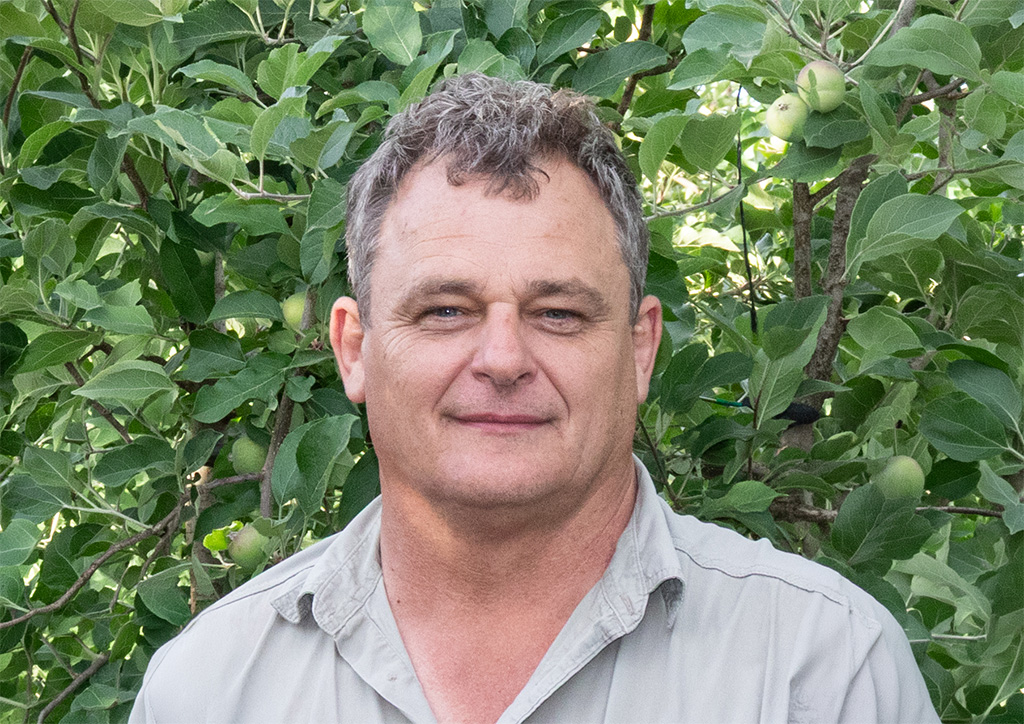
“Fruit cultivation is similar to a road trip,” said Johan Kotze, Head: Dutoit Agri Eastern Cape. “We need to know the road and the destination, but we should also be able to adjust as new information becomes available.”
Speaking at the 2026 Hortgro Technical Symposium, Kotze reviewed how technology platforms help Dutoit Agri stay on their current track of profitable fruit production. “If we digitise all the data we collect on the farm, we can create powerful maps,” he said. “But how do we transform data into information?”
From reactive to proactive
Throughout most of history, farming was reactive. A farmer noticed a problem and found a solution. Kotze thinks those days are over. Profitability has become contingent on prediction, prevention, and precision.
“Many of the older attendees will remember when our cultivar basket was just red, yellow, and green apples,” he said, “and when our spray programmes had five products we applied throughout the season.”
Now, growers must pick their cultivars and rootstocks with care, particularly as fruit colour (percentage and intensity) drives returns with many cultivars.
“We are more selective about where we plant new cultivars,” said Kotze. “Additionally, taste and texture have become more important, placing more focus on precise crop-load management.”
He listed many other areas that are increasingly complex, including irrigation scheduling, crop-protection programmes, regulatory and market requirements, food-safety inspections, and social audits.
Kotze argues that technology platforms can help growers navigate all these demands on their time and resources. However, he cautions against precision at the cost of accuracy. “Accuracy is how close you are to the target,” he explained. “Precision is your grouping.”
To optimise accuracy, growers and their advisers should increase the effective time they spend in the field. Businesses should employ the same systems across all their production units, and must own their data, in case they decide to migrate between platforms.
“Finally, we need to spend less time editing and analysing data, and more time actioning it,” said Kotze.
Digital platforms at Dutoit Agri
Climate and terrain
“Let’s start right, and do new orchard developments digitally,” said Kotze. “We usually have a fixed-point weather station on the farm. We can combine all the data from surrounding weather stations, turn it into spatial data, and choose the best site for a cultivar.”
Dutoit Agri uses an online climate and terrain tool that integrates climate data from a network of weather stations with digital elevation models to generate high-resolution temperature maps.
Growers can access climate and terrain platforms, for example TerraClim, to characterise the different microclimates on their farms, for example, areas with more or less chill or heat unit accumulation, frost risk, and potential for red colour development.
“This can lower the risk of planting an orchard in areas where it may underperform, which would lead to lower profits than expected,” said Kotze.
Beyond Excel sheets
“Grid sampling allows us to cater for soil variation within the orchard,” said Kotze. “However, grid samples on an Excel sheet tend to get lost in a file somewhere. If you pull the data into a platform, you can extract information, study changes over time, and address variation within the block.”
The same holds for results of leaf analysis, NDVI (normalised difference vegetation index, a measure of vigour), and yield maps. Dutoit Agri feeds all this data into platforms that provide spatial information to inform decisions, for example, on fertilisation, canopy management, chemical thinning, and even postharvest matters.
“With irrigation, when we only have data on a piece of paper, we cannot really add value to any of the readings,” said Kotze. In contrast, when digitised, even the feel test for soil moisture, which requires nothing more than an auger or spade, can be useful, especially when combined with probe readings.
“We can get an overall view of the entire farm from something as simple as a spade or auger if we capture the data correctly,” said Kotze.
Crop load and fruit size
“Fruit counts are often reported as averages for the block,” said Kotze. “We know we have variation within orchards. We cannot be satisfied with blind spots.”
Instead, Dutoit Agri represent their fruit counts spatially, so they can see which areas in a block need additional thinning or grooming to achieve the correct crop load. Their methods for monitoring fruit counts and size range from good, old-fashioned humans to fruit-sizing cameras.
Keeping a digital eye on fruit size relative to a growth curve throughout the season provides an indication of expected fruit size at harvest or a potential opportunity to manipulate it.
“Fruit distribution helps with planning of orchard allocation for storage and marketing,” said Kotze. It also flags high-risk areas for postharvest disorders.
He used bitter pit, which is associated with large fruit, as an example. “If we see the fruit are too large, we can manage it with deficit irrigation, and we can do early mineral analysis to determine the risk of bitter pit at harvest,” he said.
Boots in the orchard
“When in doubt, go for a walkabout,” said Kotze. “But when you do visit the orchard, capture your observations electronically.” He joked that older people, like himself, don’t remember as well as they think. Of course, this is true for everyone.
A big benefit of recording observations digitally is that the information is readily accessible and can be shared with technical advisers. Since GPS is ubiquitous on devices, it’s easy to link observations to locations, so revisiting a specific part of the orchard, or even a particular tree, is possible.
However, Kotze encouraged his audience not to confine their visits to the same spots in the orchard. “Stop in different parts,” he said. “You will see something new every time.”
He offered practical tips when using digital platforms. If possible, sharing data between platforms enables additional functionality. “When you do this, the name of the orchard and the cultivar must match 100%, or you will lose information,” he warned.
In conclusion, Kotze made a convincing case for digital platforms. By capturing and ordering data with software, the data informs systems to improve efficiency, accuracy, and profitability.
“Technology doesn’t take us out of the orchard,” he said. “There is an old saying that the fruit grower’s footprints are the best fertiliser for the trees. Now, the fruit grower will know where to walk.”
Rest-breaking in pome fruit Technical advisers from the main production regions share their approaches to rest-breaking in apples and pears. By Anna Mouton. “I…
Mitigating risks through strategic planning Johan Kotze, Dutoit Agri Head: Eastern Cape, shares some insights and strategies to mitigate climate change. By Elise-Marie Steenkamp. Dutoit…
Bring bruising under control A joint venture between Hortgro and Dutoit Agri aims to reduce losses of exportable apples due to bruising. By Anna…
Fruit quality underpins profits Tonnes are not enough — growers must focus on boosting Class 1 pack-outs. By Anna Mouton. Technical adviser Willie Kotze…
Paardekloof Maximising returns on investment. By Anna Mouton. “To earn more money, you need to put more apples into the export…
South African apple-rootstock trends The industry has come a long way since M.793 ruled the roots. Three technical advisers discuss the journey and where…